Wear-Resistant Pipe Field Selection Material Guide and Regional Application Tips for Industrial Projects
Wear-Resistant Pipe: Field Selection, Material Guide and Regional Application Tips for Industrial Projects
After 12 years of onsite project consulting for mining, power plant, cement, and dredging projects across Southeast Asia, the Middle East, and Northeast Asia, I’ve seen countless costly pipeline failures that stem from simple selection and installation mistakes. Most project procurement teams focus only on initial pipe price, ignoring regional climate conditions, slurry medium characteristics, and structural matching, leading to frequent pipe abrasion, leakage, and premature replacement. A qualified wear-resistant pipe is not just a standard industrial component—it’s a customized system solution adapted to local working conditions. In this practical guide, I share real field experience, material selection logic, cross-border procurement pitfalls, and common industry errors to help project managers and B2B buyers avoid unnecessary project downtime and budget waste.Core Types of Wear-Resistant Pipeline for Industrial Working Conditions
Industrial abrasion-resistant pipe solutions are never one-size-fits-all. Different conveying media, impact angles, and operating environments require targeted pipe structures, and misclassification is the top cause of short service life on construction sites. Based on my overseas project experience, mainstream wear-resistant pipeline types applied in global industrial projects can be divided by structural form and wear-resistant technology, each with clear applicable scenarios and limitations.
Structural Classification & On-Site Application Scenarios
Straight pipes, elbows, tees, and reducers form the complete pipeline system, and elbows are always the most vulnerable part due to material impact and turbulence. For straight sections conveying fine slurry and low-impact materials, conventional lined pipes work stably. For turning points, material splitting positions, and variable-diameter sections with high scouring intensity, enhanced wear-resistant structures are mandatory. In global project delivery, I always emphasize that pipeline accessories cannot adopt unified standards, especially for high-abrasion working conditions such as mine ore conveying and river dredging slurry transportation.
Mainstream Wear-Resistant Material Structure Classification
Ceramic-lined pipe: The most widely used slurry pipeline solution for fine particle abrasion. It features high hardness, low friction coefficient, and stable anti-scouring performance, suitable for long-distance slurry conveying in chemical plants, power plant ash conveying, and dredging projects. It performs well in humid and corrosive environments.
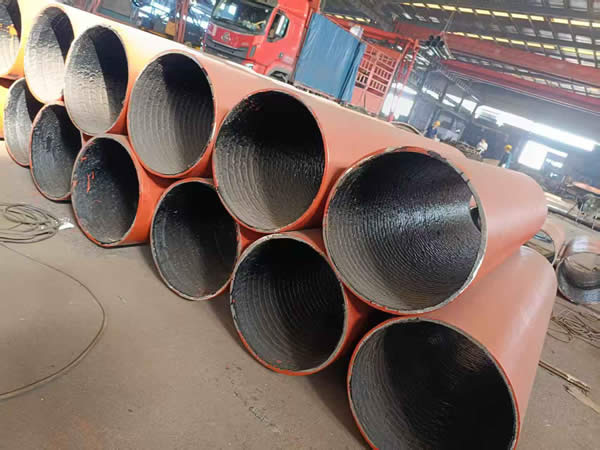
Double-metal composite pipe: Adopts outer seamless steel pipe + high-alloy wear-resistant inner layer structure, with excellent anti-impact performance. It is the preferred solution for coarse ore conveying in mining and aggregate production lines, adapting to high-impact material scouring.
Rubber/polymer-lined pipe: Outstanding anti-corrosion and anti-cavitation properties, ideal for acidic slurry and wet material conveying. It is commonly used in Southeast Asian chemical and mineral processing projects with high humidity and acidic media.
Hardfacing and high-chrome cast iron pipe: Super high wear resistance, suitable for extreme heavy-abrasion working conditions, but with poorer toughness and inconvenient construction, mostly used for fixed short-distance severe scouring sections.
Mainstream Wear-Resistant Pipe Material Performance Analysis (Pros & Cons)
Many B-end buyers only check parameter sheets during procurement and ignore the actual performance boundaries of materials under regional climatic conditions, resulting in qualified factory test data but failed on-site operation. I have sorted out the practical performance of several mainstream pipe materials based on long-term overseas project verification, combining regional temperature, humidity, and medium characteristics.
Ceramic Liner & Carbon Steel Outer Pipe Matching
The ceramic-lined wear-resistant pipe takes carbon steel (ASTM A106 standard) as the outer pipe and alumina ceramic as the inner wear-resistant layer. Its core advantage is ultra-high wear resistance, 8-15 times that of ordinary steel pipes, with extremely low flow pressure loss. The disadvantage is poor resistance to strong mechanical impact and extreme temperature difference. In Southeast Asian high-temperature and high-humidity environments, the carbon steel outer pipe is prone to salt spray corrosion if the marine packaging is not in place, which will cause the inner ceramic layer to peel off indirectly. This is a hidden problem that many suppliers fail to remind buyers of.
Double-metal and hardfaced pipes use high-chromium alloy or high-manganese steel as the inner layer, with strong impact resistance and high-temperature resistance. It can adapt to the extreme dry heat and strong sunlight exposure in the Middle East, and will not deform or fail due to thermal expansion and contraction under 50℃+ surface temperature. The weakness is that the anti-corrosion performance is average, and sand and dust in the Middle East will cause continuous micro-abrasion on the outer pipe, requiring regular anti-rust maintenance.
Polymer & Rubber Lining Materials
This type of material has excellent acid and alkali corrosion resistance, perfectly adapting to acidic mine water and muddy slurry in rainy seasons in Southeast Asia. It can effectively prevent pipeline blockage caused by material adhesion. However, it is not suitable for high-temperature working conditions. In the continuous high-temperature exposure environment in the Middle East, the rubber lining is easy to age and crack, leading to pipeline failure.
Regional Working Condition Adaptation: SEA, Middle East, Japan & Korea
There is no universal wear-resistant pipe for all global projects. The core of accurate selection is to match local climate, medium, and industry standards. Based on my project experience in three major regional markets, I summarize exclusive adaptation rules for buyers and project engineers.
Southeast Asia: High Humidity, Salt Spray & Acidic Slurry Working Conditions
Southeast Asian mining, dredging, and cement projects are faced with typical characteristics of year-round high temperature and high humidity, coastal salt spray erosion, and rainy season muddy slurry. Ordinary wear-resistant steel pipes are prone to outer wall rust and internal scale deposition. For coastal mine slurry pipelines, I recommend ceramic-lined or rubber-lined structures with enhanced anti-corrosion outer coating. In addition, sea transportation leads to long-term damp stacking of pipes, and unqualified packaging will cause flange and weld corrosion, which directly affects on-site installation sealing. Engineer’s Pitfall Reminder: Never ignore marine anti-rust packaging costs to save procurement budget; minor corrosion during transportation will lead to on-site installation rework and hidden leakage risks.
Middle East: Dry Heat, Sand Abrasion & Large Thermal Expansion
Middle East power plant and mining projects are dominated by dry and hot desert climates, with strong solar radiation, frequent sandstorms, and large day and night temperature differences. The biggest pipeline failure causes are sand dust micro-abrasion and structural deformation caused by thermal expansion and contraction. For outdoor overhead pipelines, double-metal wear-resistant pipe is more reliable than ceramic-lined pipe, as it has stronger structural toughness. Meanwhile, flange sealing parts need to adopt dust-proof and high-temperature resistant gaskets to avoid sand infiltration leading to sealing failure. Engineer’s Pitfall Reminder: Do not select flexible polymer-lined pipes for fully exposed outdoor sections in the Middle East; high-temperature aging will shorten the service life by more than 60**.
Japan & Korea: Standardized Construction, Seismic Design & Strict Acceptance
Japanese and Korean industrial projects represented by power plants and chemical plants have extremely strict construction specifications, following JIS G 3459 and KS D 3562 standards uniformly. The on-site installation space is compact, and all pipelines need to match professional seismic supports. Unlike Southeast Asian and Middle East projects that focus on wear resistance alone, Northeast Asian projects require both wear resistance and structural stability. The pipe wall thickness, flange precision, and welding process must fully comply with local industry standards, and the acceptance process covers material component testing and seismic performance inspection.
Overseas Cross-Border Procurement Key Notes for Wear-Resistant Pipe
Cross-border procurement of abrasion-resistant pipe involves standard matching, regional condition adaptation, budget control, and acceptance specifications. Many overseas buyers encounter problems such as non-compliant products, unadapted working conditions, and delayed project progress due to unfamiliarity with industry rules.
Standard Matching for Different Regional Markets
Procurement must prioritize local mandatory standards. Projects in Japan and South Korea must strictly follow JIS and KS standards for pipe size, flange parameters, and material inspection reports; Middle East energy projects usually refer to API 5L and ASTM A106 standards; Southeast Asian projects have relatively flexible standards but need to adapt to local marine and humid working conditions. Customized non-standard pipes must be confirmed with dimensional drawings and inspection reports in advance to avoid on-site installation mismatch.
Budget & Quality Balance Logic
Low-price procurement is the biggest misunderstanding in pipeline project purchasing. Wear-resistant pipe is a consumable engineering component, and low-cost inferior products will lead to frequent replacement, long-term shutdown losses, and higher comprehensive costs. For high-abrasion sections such as elbows and tees, it is necessary to configure high-grade wear-resistant structures; for low-scouring straight sections, conventional qualified products can be used to realize graded matching and optimize overall procurement cost.
Cross-Border Inspection & Delivery Pitfalls
Sea transportation cycle is long, and pipes are prone to collision deformation and salt spray corrosion. It is necessary to require suppliers to adopt independent packaging for elbows and vulnerable parts, and add anti-rust oil and waterproof wrapping. Before shipment, factory inspection shall focus on the bonding tightness of the wear-resistant layer and the wall thickness uniformity, to avoid unqualified batch products arriving overseas.
Daily Operation & Maintenance Guide for Long-Term Service Life
Excellent pipeline performance depends not only on correct selection but also on standardized daily maintenance. Reasonable inspection and maintenance can extend the service life of wear-resistant pipeline by 30**-50**, which is an important cost-saving link easily ignored by project teams.
Regular Inspection & Thickness Detection
Focus on regular ultrasonic thickness measurement for elbows, tees, and variable-diameter sections with the most severe abrasion. For Southeast Asian projects with high humidity, check the outer pipe anti-corrosion coating and support corrosion every month; for Middle East outdoor pipelines, check for lining aging and sand-induced abrasion marks regularly. Record detection data continuously to predict replacement cycle in advance and avoid sudden pipeline rupture.
On-Site Maintenance & Troubleshooting
For local peeling and slight wear of the lining, professional wear-resistant repair welding and coating can be used for reinforcement; for severely worn elbows, direct replacement is recommended to avoid pipe burst risk. In rainy seasons in Southeast Asia, clean pipeline internal sludge and scale regularly to prevent blockage and local accelerated abrasion. For Middle East pipelines, regularly clean dust on the pipe surface and reinforce flange dust-proof measures.
Many buyers simply take material hardness as the only selection index, blindly choosing ultra-high hardness wear-resistant materials. In fact, ultra-high hardness materials often have poor toughness and weak impact resistance. For mining working conditions with large particle ore impact, high-hardness brittle ceramic lining is easy to crack and peel off, while medium-hardness and high-toughness double-metal pipes have longer service life. Hardness adaptation, not super hardness, is the core of correct selection.
Misunderstanding 2: Uniform Pipeline Configuration for the Whole System
Most projects adopt the same pipe type and specification for the entire conveying pipeline, which is a typical waste of cost and hidden danger of failure. The straight section has low material scouring intensity, while the turning and splitting section bears 3-8 times the abrasion force of the straight section. Uniform configuration will either cause excessive cost investment in straight sections or premature failure of key vulnerable sections. Graded matching according to actual scouring intensity is the most scientific selection scheme.
Final Summary & Practical Project Suggestions
The selection, procurement, installation, and maintenance of wear-resistant pipe is a systematic project that must be combined with regional climate characteristics, working condition medium, and project standards. Southeast Asian high-humidity salt spray environments focus on anti-corrosion and anti-slurry scaling, Middle East dry-heat sandstorm environments focus on thermal deformation resistance and dust-proof sealing, and Japanese and Korean standardized projects focus on standard matching and seismic stability. Avoiding high-frequency selection misunderstandings and adopting graded configuration and standardized maintenance can fundamentally reduce pipeline operation costs and project downtime risks. For mining, dredging and chemical industrial projects in Southeast Asia, selecting a professional and experienced wear-resistant pipe supplier in Southeast Asia can effectively solve regional working condition adaptation and cross-border after-sales problems, and realize long-term stable operation of the pipeline system