Wear-Resistant Pipe Performance Custom Specs and Installation Tips for Global Industries
Wear-Resistant Pipe Performance, Custom Specs and Installation Tips for Global Industries
Having spent a decade solving pipeline abrasion and blockage issues for global aggregate, chemical, and port dredging projects, I’ve noticed a recurring pain point for B2B project managers: generic standard pipes always fail to match site-specific working conditions. A properly selected wear-resistant pipe does not merely extend service life—it stabilizes slurry pipeline flow, cuts unplanned maintenance downtime, and lowers long-term operational costs significantly. Many procurement teams only focus on nominal pipe specs while ignoring pressure tolerance, temperature adaptability, and regional environmental interference, leading to frequent elbow wear and internal scaling. This article shares practical field-tested performance data, custom specification rules, and cross-border installation know-how for industrial wear-resistant pipeline systems.Industrial Wear-Resistant Pipeline Core Performance & Operational Efficiency
On-site pipeline performance is far more critical than theoretical factory parameters. For industrial scenarios including port dredging, chemical slurry transportation, and aggregate sand conveying, key indicators like wear lifespan, pressure resistance, temperature tolerance, and flow loss directly determine project operational efficiency. As a field engineer, I prioritize practical performance matching over standard parameter compliance for all overseas project designs.
Wear Lifespan & Impact Resistance
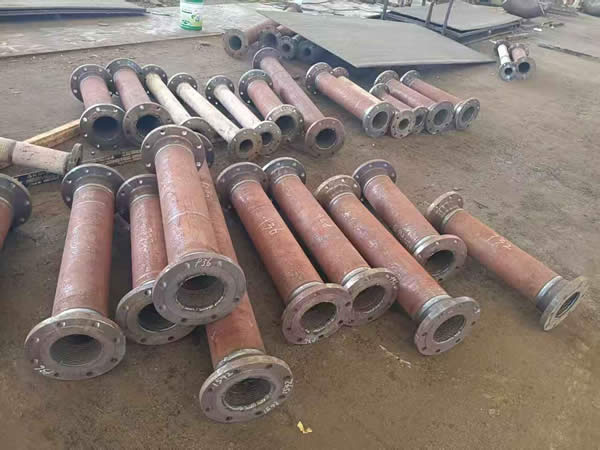
Different liner structures deliver vastly different anti-abrasion results. Traditional seamless steel pipes wear out within 3–6 months when conveying coarse sand and mineral aggregates. A qualified ceramic-lined pipe can extend service life to 3–5 years for fine and medium particle slurry, while bimetallic wear-resistant pipe is ideal for high-impact aggregate conveying scenarios. It resists continuous material impact at turning points and effectively avoids local pipe wall thinning, a common failure at wear-resistant elbow positions.
Pressure, Temperature Tolerance & Flow Loss Control
Most industrial pipeline failures stem from ignored pressure and temperature limits. Standard abrasion-resistant pipe for general industrial use supports working pressure up to 16MPa, meeting most cement and chemical plant needs. For high-pressure port dredging projects, customized thick-walled structures are required. In terms of temperature adaptation, composite lined pipes work stably from -20℃ to 350℃, avoiding thermal deformation and liner peeling. Smooth inner walls also reduce pipeline pressure loss, ensuring stable long-distance material conveying efficiency.
Anti-Blocking & On-Site Installation Efficiency
Smooth inner liners of optimized wear-resistant pipeline prevent adhesion of viscous chemical slurry and wet aggregate mud, greatly reducing blockage frequency. Meanwhile, integrated flange and quick-clamp structures simplify on-site installation, cutting construction time by nearly 40** compared with traditional welded steel pipes, which is extremely suitable for tight-schedule overseas renovation projects.
Custom Size & Non-Standard Specification Engineering Solutions
Over 60** of overseas industrial pipeline projects cannot rely on standard off-the-shelf pipes. Complex pipe layouts, special conveying angles, and limited on-site space require professional custom sizing. Standard DN/OD specifications cannot fully adapt to differentiated working conditions in Southeast Asia, the Middle East, and Japan & Korea.
Conventional Standard Parameter Matching
Common industrial pipe specifications cover DN50 to DN800, with customizable wall thicknesses and single pipe lengths. Straight pipes are usually customized in 3m–6m standard lengths to fit international container shipping standards and reduce transportation costs. Elbows support 30°, 45°, 60°, and 90° conventional angles, covering most slurry pipeline turning layout needs for mines and chemical plants.
Non-Standard Customization for Special Project Scenarios
Many overseas projects require non-standard customization based on site constraints. Japanese and Korean chemical plants feature ultra-narrow installation spaces, requiring shortened pipe bodies and optimized flange sizes compliant with KS D 3562 standards. Middle East thermal power projects need ultra-long single pipes to reduce on-site welding joints and lower sand dust erosion risks at welding seams. Southeast Asian dredging projects require irregular reducing pipes to match old pipeline renovation layouts.
Engineer’s Pitfall Reminder: Always confirm on-site layout drawings and local industry standards before customizing non-standard pipes. Blind customization leads to installation mismatch and costly return and rework for cross-border projects.
Regional Working Condition Adaptation for Three Core Overseas Markets
No universal pipeline solution fits all global regions. The high-temperature humid climate of Southeast Asia, dry and windy desert environment of the Middle East, and standardized high-precision construction requirements of Japan and Korea put forward completely different adaptation demands for wear-resistant pipe systems.
Southeast Asia: High Humidity, Salt Spray & Seasonal Muddy Working Conditions
Coastal mine and port projects in Southeast Asia suffer from year-round high temperature, high humidity, and severe salt spray corrosion. Ordinary carbon steel outer pipes are prone to outer wall rust and pipe bracket corrosion. Rainy seasons bring a large amount of high-viscosity acidic muddy slurry, which easily adheres to pipe walls and causes local accelerated abrasion. In addition, long-term sea transportation leads to damp stacking, and unprotected flange ends will rust before installation.
Middle East: Dry Heat, Strong Sun Exposure & Sand Abrasion
Middle East mining and power plant projects face extreme dry heat and intense solar radiation. Pipeline structures bear frequent thermal expansion and contraction, leading to loose flange seals if the structure is not optimized. Seasonal sandstorms cause persistent fine dust micro-abrasion on outer pipe walls, and unprotected welding seams are the first to be worn and damaged. Meanwhile, local project standards require strict fireproof performance for outdoor overhead pipelines.
Japan & Korea: Compact Layout, Seismic Design & Strict Acceptance
Industrial projects in Japan and Korea follow JIS G 3459 and unified local acceptance standards with zero tolerance for unqualified products. The most prominent feature is compact on-site installation space, requiring ultra-precise pipe sizing. All pipeline systems must be matched with professional seismic brackets to resist regional seismic risks, and every batch of pipes needs complete material test reports and factory certification before admission.
Overseas B2B Procurement Rules & Regional Acceptance Avoidance Tips
Cross-border procurement of abrasion-resistant pipe involves standard docking, regional working condition adaptation, and hidden acceptance risks. Many overseas buyers save upfront costs but fall into long-term operational traps due to unfamiliarity with local project rules.
Regional Standard Docking Requirements
Middle East energy projects prioritize API 5L and ASTM A106 material standards, focusing on high-temperature resistance and structural stability. Japanese and Korean projects strictly enforce JIS and KS dimensional standards, with full inspection of flange flatness, pipe wall thickness uniformity, and welding seam quality. Southeast Asian projects have flexible standards but require enhanced anti-corrosion packaging for sea transportation.
Budget & Acceptance Hidden Pitfalls
Most low-cost procurement schemes omit hidden costs such as enhanced anti-rust packaging and customized inspection reports. Pipes arriving at Southeast Asian ports often have surface rust due to insufficient packaging, failing on-site acceptance. Middle East projects will reject products without fireproof and dust-proof certification for outdoor pipelines.
Engineer’s Pitfall Reminder: Do not take domestic standard products as universal export products. Add targeted anti-corrosion, dust-proof, and standardized certification processes according to regional requirements to avoid acceptance failure.
Exclusive Module: Traditional Steel Pipe vs Modern Wear-Resistant Pipe Solution Comparison
Many project teams still stick to traditional ordinary steel pipes and common anti-abrasion solutions due to inertial thinking. Through hundreds of overseas project comparisons, I summarize the core differences in service life, cost, and regional adaptability to help buyers make accurate solution selections.
Service Life & On-Site Stability Comparison
Ordinary carbon steel pipes have low hardness and poor anti-scouring ability, with a service life of only 3–8 months in medium and high-abrasion scenarios such as aggregate conveying and chemical slurry transportation. Traditional single-layer wear-resistant coating pipes are prone to coating peeling under high temperature and humid environments, with unstable performance. In contrast, modern composite wear-resistant pipeline structures (ceramic-lined, bimetallic composite) integrate wear-resistant and structural layers, with a service life 8–12 times that of ordinary steel pipes, and no peeling failure occurs under extreme regional climates.
Comprehensive Operational Cost Comparison
Traditional steel pipes have low initial procurement costs but require frequent replacement, shutdown maintenance, and on-site welding rework, resulting in extremely high long-term comprehensive costs. Their rough inner walls cause large flow pressure loss, increasing long-term equipment operating power consumption. Modern optimized wear-resistant elbow and straight pipe solutions have slightly higher initial investment but greatly reduce maintenance frequency and energy consumption, cutting the overall pipeline system operation cost by more than 40** within two years, which is more in line with the cost control needs of medium and large overseas industrial projects.
Conclusion
Selecting a matched wear-resistant pipe is not a simple standard procurement work, but a systematic solution design combining regional climate, working condition medium, project standards, and cost control. Traditional steel pipe solutions are no longer suitable for high-standard overseas industrial projects, while customized modern wear-resistant pipeline systems can adapt to the high humidity of Southeast Asia, dry heat of the Middle East, and high-precision construction needs of Japan and Korea. For mining and energy projects in the Middle East, professional wear-resistant pipe for Middle East mining can perfectly solve local sand abrasion and thermal expansion problems, ensuring long-term stable operation of the pipeline system.