Wear-Resistant Pipe Material Analysis Operational Efficiency and Regional Procurement Guide for Slurry Conveying
Wear-Resistant Pipe: Material Analysis, Operational Efficiency and Regional Procurement Guide for Slurry Conveying
After over a decade of field engineering and B2B procurement consulting for industrial conveying projects across Southeast Asia, the Middle East, and East Asia, I’ve witnessed a recurring operational pain point: most slurry pipeline downtime stems from mismatched material selection and overlooked regional climatic factors, rather than poor construction quality. A properly specified wear-resistant pipe can eliminate 90** of unexpected pipe burst and blockage issues for cement, mining, and chemical slurry systems. In this practical guide, I share real-field insights on material performance, operational efficiency, customized specification design, cross-border procurement rules, and exclusive hidden failure causes, helping project managers and procurement teams avoid costly on-site rework and frequent part replacement.
1. Core Industrial Value of Wear-Resistant Pipeline Systems
Industrial slurry and granular material conveying is one of the most abrasive working conditions for pipeline systems. Ordinary carbon steel pipelines that work fine for clean water or gas will thin rapidly under continuous impact from ore particles, cement clinker, and chemical slag. A professional wear-resistant pipeline is engineered specifically to tackle solid particle erosion, slurry scouring, and mild chemical corrosion, delivering stable long-term operation for heavy-duty industrial production lines.
Different industrial scenarios bring distinct operational values. For cement and chemical plants running 24/7, these pipelines cut frequent maintenance shutdowns caused by inner wall abrasion. For mining and river dredging projects, they resist high-speed sediment and ore scouring that would wear out standard pipes in months. For sand and aggregate processing lines, they withstand sharp granular impact that easily damages conventional piping systems.
Regional environmental differences further amplify the necessity of targeted pipeline selection. Southeast Asian industrial sites suffer from year-round high temperature and humidity, coastal salt spray corrosion, and acidic mine water in rainy seasons, which erode both pipe exteriors and internal liners. Middle Eastern desert projects face extreme dry heat, intense UV exposure, and frequent sandstorms that cause surface abrasion and thermal expansion deformation. Japanese and South Korean industrial parks feature ultra-compact installation spaces, mandatory seismic support standards, and strict JIS and KS acceptance regulations that demand precise, standardized pipeline configurations.
2. Mainstream Wear-Resistant Pipe Material Performance Analysis (Pros & Field Limitations)
Many overseas purchasers only compare prices and basic pipe sizes during sourcing, ignoring the core performance gaps of different abrasion-resistant pipe materials that determine actual service life. Based on hundreds of cross-border project debugging experiences, I’ve sorted out the practical advantages, shortcomings, and regional adaptability of three mainstream pipeline materials for industrial slurry conveying.
2.1 Ceramic-Lined Pipe
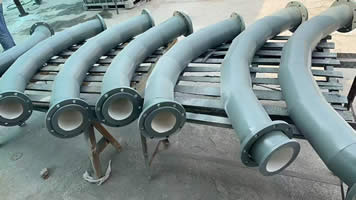
Ceramic-lined pipe is the most cost-effective solution for fine slurry and low-impact material conveying. The high-purity alumina ceramic inner lining boasts ultra-high hardness and an extremely smooth inner wall, which effectively reduces flow pressure loss and prevents slurry scaling and blockage. It performs excellently in Southeast Asia’s humid, acidic mine water conditions, with strong resistance to mild chemical corrosion and moisture aging.
The obvious limitation is poor heavy impact resistance. This slurry pipeline cannot bear continuous striking from large ore stones and thick slag, making it unsuitable for heavy mining and metallurgy working conditions. It is ideal for cement plant slurry, power plant ash, and fine chemical powder conveying.
2.2 Dual-Metal Composite Wear-Resistant Pipe
Composed of a carbon steel outer pipe and high-chromium cast iron wear layer, dual-metal wear-resistant pipe features outstanding anti-impact and anti-cutting abrasion performance. Its service life is 6–8 times longer than ordinary steel pipes, perfectly adapting to the Middle East’s harsh desert working conditions, including high-temperature exposure, sandstorm scouring, and large-particle mineral conveying.
Its main weakness is higher fluid resistance compared with ceramic-lined pipe and heavier overall weight. For this reason, it requires reinforced pipe support and seismic structure design for Korean and Japanese projects that comply with strict seismic codes.
2.3 Rubber & Polymer Lined Pipe
Rubber and polymer lined pipes excel in anti-corrosion and anti-adhesion performance, perfectly solving scaling and blockage problems in humid and acidic slurry. They are widely applied in Southeast Asian rainy season mud conveying and chemical acidic wastewater transportation. However, the temperature resistance limit is only 80℃, so they cannot be used for Middle Eastern high-temperature exposed pipelines or high-temperature slag conveying systems.
3. Key Performance Parameters & On-Site Operational Efficiency
Nominal parameters on product sheets cannot reflect real on-site performance. As a field engineer, I always evaluate wear-resistant pipeline systems based on practical operational indicators that directly affect production efficiency and maintenance costs.
3.1 Service Life & Anti-Abrasion Stability
Under standard working conditions, ceramic-lined pipes operate stably for 5–7 years in fine slurry scenarios; dual-metal pipes maintain stable performance for 4–6 years under heavy particle impact; rubber-lined pipes work continuously for 3–5 years in corrosive slurry environments. Reasonable material matching can completely avoid seasonal pipe thinning and sudden pipeline failure.
3.2 Pressure & Temperature Resistance Adaptability
Qualified products compliant with ASTM A106 and API 5L standards support 1.6MPa to 10MPa pressure, covering most industrial long-distance conveying requirements. Dual-metal pipes resist temperatures up to 350℃ for high-temperature industrial slag conveying, while ceramic-lined pipes adapt to working temperatures below 200℃. For Middle East projects, reserved thermal expansion gaps are essential to prevent flange leakage and pipe deformation under extreme heat.
3.3 Flow Efficiency & Anti-Blocking Performance
Smooth-lined ceramic wear-resistant elbow and straight pipes greatly reduce slurry adhesion and flow resistance, lowering long-term pump energy consumption. This advantage is particularly prominent in Southeast Asian high-humidity environments where slurry is prone to sticking and scaling, effectively reducing manual cleaning frequency and production downtime.
Engineer’s Field Reminder: Never pursue ultra-lightweight pipe design by thinning the wear layer. 70** of overseas pipeline burst accidents are caused by insufficient wear layer thickness to save initial costs.
4. Standard Specification & Non-Standard Project Customization
Standard DN-sized pipelines cannot meet all overseas project requirements, especially for renovated old factories, compact East Asian workshop layouts, and special medium conveying lines. Professional customized sizing is the key to full on-site compatibility.
4.1 International Standard Specification Matching
All our standard pipes strictly follow ISO 9001, JIS G 3459, and KS D 3562 standards. Conventional DN50 to DN800 straight pipes, 45° and 90° wear-resistant elbow, and equal tees are in stock for fast delivery, suitable for most new cement plant and mining projects worldwide.
4.2 Regional Targeted Non-Standard Customization
For Southeast Asian port and dredging projects, we customize ultra-long single-section pipes to reduce on-site welding joints and minimize salt spray corrosion risks. For Middle Eastern desert projects, we thicken the wear layer of elbows and tees to enhance sandstorm abrasion resistance. For Japanese and Korean compact factories, we customize special-angle pipelines and ultra-short reducers to adapt to narrow installation spaces while matching dedicated seismic bracket sizes.
5. Overseas Procurement Rules for Southeast Asia, Middle East and East Asia
Cross-border pipeline procurement is never a simple material purchase. Different regions have unique hidden risks in working conditions, packaging, installation, and acceptance. Generic procurement schemes always lead to unqualified construction and shortened pipeline lifespan.
5.1 Southeast Asia Procurement Focus
High humidity, coastal salt spray, and acidic slurry are the top threats. All outer pipes must adopt hot-dip galvanizing and anti-rust double coating. Sea freight packages require full waterproof and moisture-proof sealing to avoid container rust during long ocean transportation. Pipeline supports also need enhanced anti-corrosion treatment to resist rapid salt spray aging.
5.2 Middle East Procurement Focus
Dry heat, strong UV radiation, and frequent sandstorms require pipelines with high temperature resistance and anti-aging performance. Flange gaskets must use high-temperature resistant materials to prevent aging and leakage under long-term solar exposure. External UV-resistant coating is mandatory to slow surface abrasion and thermal deformation.
5.3 Japan & South Korea Procurement Focus
These regions implement the strictest acceptance standards. All pipe dimensions, welding processes, and flange parameters must fully comply with JIS and KS standards. Seismic brackets and limit supports are mandatory for all pipeline systems, with zero tolerance for unqualified welding and component mismatch.
Engineer’s Field Reminder: Do not match Chinese standard flanges with JIS or KS standard pipes. Dimension mismatch will cause on-site rework and huge economic losses.
6. Exclusive: Hidden Pipeline Failure Causes & Targeted Troubleshooting Solutions
Most project teams only focus on obvious pipe breakage and blockage, ignoring hidden gradual failure problems that shorten the service life of abrasion-resistant pipe systems. After sorting out years of overseas maintenance cases, I summarize the two most common hidden failures and practical field solutions.
6.1 Hidden Failure 1: External Corrosion Induced by Regional Climate
Many purchasers only pay attention to internal wear resistance and ignore external pipe protection. In Southeast Asian coastal areas, salt spray will corrode unprotected outer pipes and welding seams within one year, leading to outer wall rust penetration and pipeline scrapping. In the Middle East, long-term UV exposure causes outer paint peeling and base metal aging, weakening overall pipeline structural stability.
Troubleshooting Solution: Match targeted surface treatment according to regional climate. Add salt-spray resistant coating for Southeast Asian projects and UV-proof topcoat for Middle Eastern pipelines. Conduct quarterly outer wall rust inspection during daily operation.
6.2 Hidden Failure 2: Asymmetric Wear of Pipeline Vulnerable Parts
Most slurry pipeline failures come from uneven wear of elbows and tees, not straight pipes. Due to slurry impact and flow direction change, local thinning of elbows is far more serious than straight sections. Uniform pipe configuration leads to partial over-wear and system shutdown, even if most straight pipes are still intact.
Troubleshooting Solution: Implement graded wear protection. Upgrade elbows, tees, and reducers with thickened wear layers, and adopt cost-effective standard pipes for straight sections. Regularly test wall thickness of vulnerable parts to realize pre-maintenance and avoid sudden shutdowns.
7. Conclusion
Selecting a qualified and regionally adapted wear-resistant pipe is the core of stable long-term operation for industrial slurry conveying systems. Different materials, specifications, and protection schemes must match local climate and working conditions: ceramic-lined pipes suit humid and anti-scaling scenarios in Southeast Asia, dual-metal pipes adapt to high-impact desert mining in the Middle East, and customized standardized pipelines fit high-precision seismic projects in Japan and South Korea. As a professional wear-resistant pipe supplier for Middle East mining and Southeast Asian industrial projects, we provide one-stop material selection, customization, and after-sales technical support for global industrial pipeline systems.