Wear Resistant Pipe Selection Handbook
Wear Resistant Pipe Selection Handbook
What a Wear-Resistant Pipe Actually Does on Site
I pulled a 6-inch carbon steel elbow out of a copper-gold mine in Kalimantan last wet season that had thinned to a knife edge in eleven months. The slurry was pH 3.8, loaded with quartz, and the crew had been patching it with clamp-on sleeves every other month. That is the moment a lot of buyers finally understand why a proper wear-resistant pipe costs three to five times a bare A106 line. It is not a commodity. It is a wear part you bury in the ground or hang on a pipe rack, and if you choose it wrong, you are not saving money—you are just deferring the shutdown.
Across mines, cement plants, power stations, dredging projects and chemical plants in Southeast Asia, the Middle East and Japan, the job of this pipe is simple: carry abrasive, often corrosive, sometimes hot slurry or ash without bursting, without clogging, and without forcing the maintenance crew onto a scaffold every quarter. The ROI shows up as fewer shutdown days, lower spare-parts inventory, and a quieter EPC acceptance meeting.
Material Choices That Actually Survive Field Conditions
Before we talk about types, let us get the materials straight, because 80** of the arguments I see on site come from people comparing ceramic-lined pipe against high-chrome pipe without knowing what each one is bad at.
Ceramic-Lined Systems
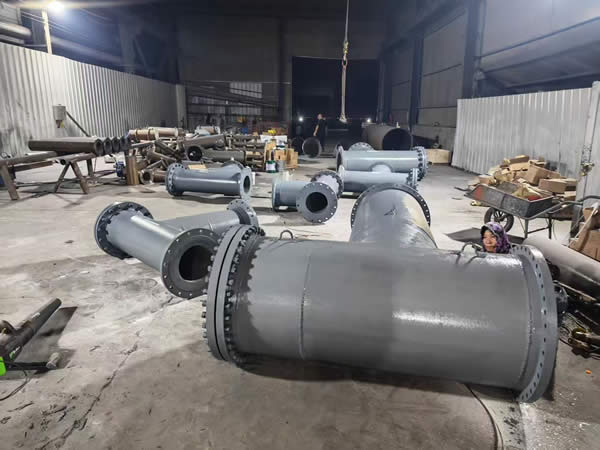
A ceramic-lined pipe is basically a steel outer tube with an alumina (or sometimes zirconia) sleeve bonded inside. Hardness is 80+ on the Mohs scale, so it eats quartz for breakfast. It is the default choice for fine slurry, pneumatic ash, and concentrate lines. The catch: ceramics are brittle. Drop a large lump ore on a vertical riser elbow and you can crack the liner. The bond layer also fails if you run the line above 350°C for long. I have seen ceramic elbows delaminate in Saudi cement kiln bypass lines where ambient was 55°C and the flue gas hit 400°C—swelling the outer tube and popping the sleeve loose.
Double-Metal and High-Chrome Castings
Chromium-white iron (27** to 30** Cr) elbows and tee pieces handle impact way better than ceramic. They are heavier, harder to weld onto carbon steel mains, and more expensive per kilo, but for coarse ore, mill discharge, and dredge cutter suction lines, they earn their keep. Outside in a JIS G 3459 stainless-clad arrangement for a Korean chemical plant, the outer shell was KS D 3562 compliant and the inner liner was 27Cr—that is a belt-and-suspenders setup for acidic slurry near Busan.
Rubber and Polymer Linings
Natural or synthetic rubber lined pipe is quiet, smooth, and great for acidic mine water where abrasion is moderate but corrosion is nasty. But in the Middle East sun, rubber degrades fast. UV plus 60°C surface temperature turns it brittle in two years. I spec rubber lining only for covered trenches or indoor racks, never exposed in Riyadh.
Performance Numbers You Can Actually Use
Engineers love datasheets, but let me give you the field version. A well-designed abrasion-resistant pipe in a 30** solids quartz slurry will typically outlast a standard A106 carbon steel line by 6 to 12 times on the same duty. On a slurry pipeline with 100 mesh concentrate, a ceramic-lined straight pipe can run 5 to 8 years before measurable thickness loss; a high-chrome wear-resistant elbow at the bend may need replacement at 18 to 30 months—elbows always fail first, plan for it.
Pressure, Temperature and Flow
Most overseas specs sit at PN10 or PN16 for slurry. Middle East fire-code projects may push PN25 on ash lines. Keep an eye on thermal growth: in Riyadh, a 30-meter carbon steel run swings 45°C between night and midday, that is 17 mm of linear expansion—your guides and anchor points must absorb it or the flanges weep. On flow, ceramic lining has a smoother ID than cast high-chrome, so pressure drop is lower; that matters if you are sizing a booster pump.
Impact and Anti-Clogging
Coarse lumps hate small-radius bends. If your ROM feed has +100 mm rocks, do not put a 1.5D elbow—use a 5D or a through-loading tee (the self-wearing pocket design) and you will not believe how long it lasts.
The Mistakes Buyers Make on First Orders
This is the section I wish I had written ten years ago. First-time overseas buyers consistently repeat the same errors, and each one costs them money on installation day.
Specifying by Price Per Meter Instead of Cost Per Ton Moved
A cheap rubber-lined pipe looks great on the BOQ. But if it needs replacing in 18 months and a ceramic-lined equivalent runs 6 years, the per-meter price is irrelevant. Divide the installed cost by the lifetime tonnage moved. That is the only number that matters to your operations director. Pitfall warning: I once watched a cement plant in Jordan accept a low bid that saved them 20** on pipe cost, only to spend three times that amount on three unplanned shutdowns in the first year.
Ignoring the Flange and External Coating Detail
The pipe body will outlast your career. The flange face, the bolting, and the external coating will not. In Southeast Asia's salt spray and rainy-season humidity, an uncoated carbon steel flange starts rusting in the crate before you unload it. Specify epoxy fusion-bonded coating externally, a raised face with a temporary flange protector, and hot-dip galvanized backing flanges if the line is above ground. In the Middle East, add a dust-excluding gasket type—sand under a flange bolt is a leak waiting to happen.
Under-Specifying Elbow Radius and Wall Thickness
Straight pipe life is easy to predict. Elbow life is where the money burns. If the supplier quotes you the same wall thickness for the elbow as the straight pipe, walk away. Elbows in slurry service should run 1.5x to 2x the wear thickness of the straight section, and the bend radius should be at least 3D for slurry, 5D for pneumatic conveying. Pitfall warning: I have seen buyers accept 1D short elbows to save space on a congested Japanese plant site—they replaced four elbows in six months and rewelded the pipe rack supports twice because the weight shifted.
Treating JIS, KS and EN Flanges as Interchangeable
Japanese and Korean end users check flange facing, bolting dimensions, and weld prep against JIS G 3459 or KS D 3562 without apology. A PN16 EN flange will sometimes physically bolt up to a JIS 10K flange, but the sealing ring groove, the bolt circle, and the facing height are different—do not let your supplier substitute equivalent flanges. Ask for a dimension drawing stamped by the manufacturer before shipment. ISO 9001 on the shop floor is table stakes; the flange drawing is what keeps you out of a late-night welding session.
Maintenance That Actually Extends Life
A wear-resistant pipeline is low-maintenance, not no-maintenance. Walk the line once a month with a thickness gauge on the known high-wear points—elbows, tees, reducers, and the underside of horizontal runs. Tag them. Trend the numbers. If an elbow is losing 0.5 mm per month, you have 4 to 6 months budgeted to replace it; do not wait for the leak.
- Southeast Asia: Flange rust is your enemy. After the monsoon, inspect every above-ground joint. Touch up coating damage early—once rust creeps under the epoxy, you are reblasting the whole flange face.
- Middle East: Check anchor guides and expansion joints after the hottest month. Dust on flange faces means the gasket is doing double duty; clean and re-torque on a scheduled cycle, not when it starts weeping.
- Japan and Korea: Seismic supports shift slightly after any tremor. Re-check bolt torque and liner tightness on elevated racks. Their inspection teams will do this anyway—be ahead of them.
For storage, keep spares off the dirt, under cover, with flange protectors on. In tropical humidity, a bare steel flange in an open yard will rust through the primer in one wet season. Do not ship ceramic-lined pipe standing on end—store horizontally, supported at third points, or the inner sleeve can shift.
Wrapping It Up
Picking the right system is less about chasing the hardest material and more about matching the liner to the media, the external coating to the climate, and the flange standard to the end user's inspection culture. Ceramic for fine slurry, high-chrome for coarse impact, rubber for mild acid—and never, ever skimp on elbows. Whether you are quoting a gold mine in Sulawesi, a cement plant in Yanbu, or a biomass ash line in Kyushu, the same rules apply.
If you are sourcing a wear-resistant pipe for a project in the region, talk to a manufacturer who has actually shipped into your destination port, who understands salt-spray packaging, JIS and KS flanges, and Middle East dust sealing—because a wear-resistant pipe supplier in Southeast Asia who has done these jobs before will save you more in installation headaches than any discount on the unit price.