Wear-Resistant Pipe for SE Asia Slurry
Wear-Resistant Pipe for SE Asia Slurry
Eight weeks. That's how long a brand-new discharge line survived at a coal preparation plant I was called to in Kalimantan before the 90° bend blew out on the outer radius. The client had paid real money for heavy carbon steel and still lost a full production shift to a patch-and-weld job. After fifteen years specifying wear-resistant pipe for mines, power plants and dredging jobs from Jakarta to Jeddah, let me be blunt: most failures are decided before the pipe ever leaves the factory, and no amount of thick steel fixes a bad spec.
Pick a Geometry First, Then a Material
Stop thinking in "pipe sizes" and start thinking in wear zones. In any slurry line, roughly 70** of the damage happens in a small area of the pipe. That area is almost always a bend, a reducer, or a point where flow changes direction. So before you argue about wall thickness, decide which piece of the line is going to die first, and spend your budget there.
The bend is where the money goes
A straight run of pipe wears evenly. A 90° bend concentrates abrasion on the extrados — the outer curve — and that is where the first hole always appears. This is why the wear-resistant elbow is the single most important fitting in any slurry pipeline. On jobs in Southeast Asia I refuse to let a client use a plain steel elbow even on a "temporary" line, because temporary turns into permanent the minute it works.
Straight runs, reducers and tees
- Straight sections: the liner does the work, the outer shell only carries pressure — so don't over-specify the shell.
- Reducers and tees: these see turbulence and impingement, so treat them like bends, not like straight pipe.
- Connection method: flanged joints beat welding in the field every time. In humid, salty ports a weld is a corrosion starter; a flanged joint you can inspect and re-seal.
Field note: don't let your installer weld flanges on-site over the liner. I've seen heat from a weld crack a ceramic lining two metres away from the flame. Flanges belong on the fitting when it leaves the factory, or the liner warranty is already dead.
The Liner Does the Work, the Shell Carries the Load
Clients regularly ask me for a heavier outer steel pipe thinking that buys life. It doesn't. The shell is there to carry pressure and bolt to the next flange. The thing that actually survives years of abrasion is the liner, and that is where you should compare products — not on the diameter of the carbon steel outside.
Ceramic composite — the workhorse
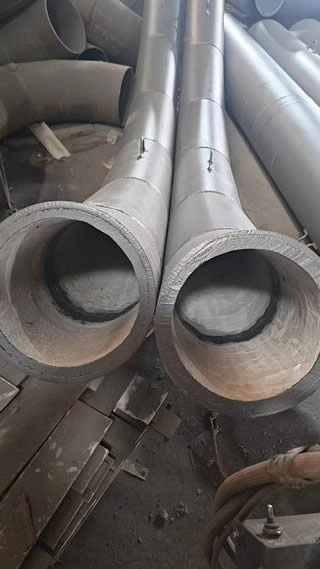
For most abrasive slurries, a ceramic-lined pipe is the honest answer. Alumina-based liners handle sliding abrasion and acidic mine water far better than any plain steel. In a tin or sand dredging job with sharp particles, ceramic eats the work instead of the wall. Just remember the liner is brittle — drop a full flange off a truck and you have a cracked liner you cannot see from the outside.
Bi-metal, overlay and high-chrome
Where the flow carries big, blunt impact — say, coarse coal or rock going through a transfer line — a bi-metal pipe with a hardened layer, or a hardfaced overlay, shrugs off hits that would shatter ceramic. High-chrome iron is cheaper and easy to cast into fittings, but it is brittle and hates thermal shock. The rule I carry: ceramic for sliding abrasion, hard metal for impact, and never let anyone sell you one material for every job.
Here's the thing most spec sheets hide: an abrasion-resistant pipe from two suppliers with the same "alumina content" can live ten years in one plant and die in one year in another, because the real difference is the bond between liner and shell and the quality of the joints. Ask for the bond method and the joint detail in writing.
Read the Numbers Like a Field Engineer
Performance is a trade, not a spec sheet fantasy. You cannot have a paper-thin, cheap, high-pressure, 900°C-tolerant pipe. Rank what matters for your line and buy accordingly.
Wear life and pressure
Ask the supplier for a wear life figure tied to your specific particle size, velocity and angle of attack — not the generic "5–10 years" everyone prints. Velocity is the killer. Double the slurry velocity and you roughly quadruple wear. If you can slow the flow down, you just bought years of life for free.
Flow, pressure loss and blockage
Lined pipe can be heavier and have a slightly rougher internal profile, which costs you head. On long pump discharge runs in flat, humid terrain this shows up as a bigger pump or a slower line. Size the bore honestly — a slurry pipeline that is marginally undersized will block, and blocked lines in the wet season are a maintenance nightmare nobody budgets for.
Field note: never accept a "drop-in replacement" that matches the outer diameter but not the internal bore. The bore is what moves your slurry. I have seen a whole line redesigned around a wrong internal diameter because someone matched OD only.
Corrosion, Scaling and Blockage — the Slurry Killers Nobody Quotes
Every tender I read quotes abrasion. Almost none quote the three things that actually end up costing downtime in the field: corrosion, scaling and blockage. Treat them as real design inputs, not afterthoughts.
Corrosion is slower, but it kills just the same
In Southeast Asia, acidic mine water and salt spray do more damage to pipe racks and flanges than the slurry does to the liner. I insist on hot-dip galvanized or painted supports, stainless fasteners on every flange, and a drainage point at every low spot. A flange bolt that rusts solid in a humid port becomes a day of cutting work to replace.
Blockage and scaling eat your schedule
Slow-moving lines, oversized pipe, or a sudden drop in velocity invites settling. Slurry that sits builds scale on the walls and narrows the bore until it plugs. Design for a velocity high enough to keep solids moving, and put cleanout access where you know the mud will settle. In the Middle East, thermal expansion across a hot day-to-night swing loosens flanges, and dust gets into everything — seal flanges properly and check them at the temperature extreme, not in the cool morning.
In Japan and Korea the expectations are different in a good way: they inspect flanges with torque wrenches, they want seismic-rated pipe supports because of the earthquakes, and they reject on JIS and KS standards without negotiation. Ship your documentation tight — a missing material test certificate is a rejection, not a request for more paperwork.
Maintenance Is Where Lifetime Is Won or Lost
Buying a good pipe is only half the job. The plants that get ten years out of a line do the same three things every shutdown.
Inspect the right layer
Most crews run an ultrasonic gauge on the outside and think they're measuring remaining life. On a lined pipe, that gauge reads the outer shell, which barely wears. You are measuring nothing. The liner is what's dying, and you cannot see it from outside. Establish a baseline at commissioning, then measure at the known wear zones — the extrados of every elbow — on a real schedule.
Replace the elbow before it fails
Because bends wear first and fast, keep a spare wear-resistant pipeline elbow on site. Swapping a flanged elbow takes a few hours; patching a blown bend takes a day and never lasts. Planned replacement of the wear part is dramatically cheaper than emergency repair.
Store and handle it right
Lined pipe should sit on saddles, off the ground, end-capped, and dry. I have watched weeks of lead time get wasted because sea-freight pipe sat in an open yard in the tropics and rusted before installation. Rust on the shell, plus moisture trapped under end caps, is a corrosion start. Protect the product from the moment it lands in the port, because that is where too many projects lose their pipe.
What You Should Actually Take Away
Pick geometry by wear zone, pick the liner by the abrasive and the impact, size the bore by flow, and budget for corrosion, scaling and the regional climate before you sign. A well-specified wear-resistant pipe installed with flanged joints and maintained at the wear points will outlast a cheaper line by years — and the difference shows up in uptime, not in the initial invoice.
If you are planning slurry, dredging or coal handling work in this region, talk to a wear-resistant pipe supplier in Southeast Asia who has actually been on site and will tell you where the liner will fail, not just what the brochure says it can handle.