Wear-Resistant Pipe Guide for Slurry Use
Wear-Resistant Pipe Guide for Slurry Use
I've been in the field on overseas slurry jobs long enough to stop believing in "universal" pipe. On a monsoon-season dredging line in Southeast Asia, we pulled a standard carbon steel straight section after nine weeks and the wall looked like someone had been filing it from the inside. That's the moment you stop buying "a pipe" and start buying a wear-resistant pipe matched to your slurry, your climate, and your crew. These are working notes, not a brochure — what actually wears out, what fails on site, and what I wish buyers in Asia and the Middle East had known before signing.
Know Your Options: Not Every Wear Pipe Is the Same
Walk into any overseas fab shop and they'll show you the same three families of pipe. The trick is knowing which one your line needs, not which one is cheapest on the first quote.
Straight Pipe and the Fittings That Carry the Real Load
A slurry line is never just straight pipe. You're buying straight sections, but the elbows, tees and reducers are where the flow energy concentrates — and where a wear-resistant pipe system either earns its keep or leaks money. On most coal prep and cement lines, the bend absorbs several times the wear of the straight run, which is why I tell buyers to spend proportionally more attention on a wear-resistant elbow than on the pipe itself. Reducers deserve the same respect: a sudden step-down in diameter speeds up the slurry, and that acceleration is pure abrasion.
Ceramic Tile-Lined vs. Monolithic Ceramic Ring
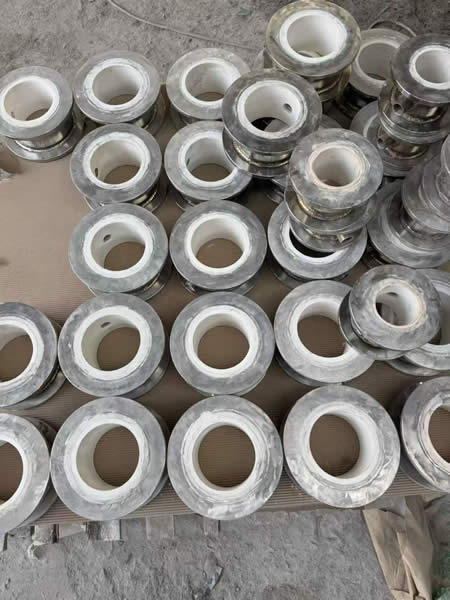
Tile-lined construction — alumina or zirconia tiles bedded into the bore — handles big lumps and gives you a repairable inner. Monolithic ceramic ring pipe, where the ceramic is cast or pressed into one continuous liner, is my first pick for fine, high-velocity slurries and for lines where tile pop-out has been a recurring headache. The trade-off is simple: tiles are field-repairable and forgiving; rings are smoother and faster but you replace a whole spool when one segment fails.
Flanged or Welded?
For overseas projects I default to flanged spools wherever the site allows it. Flanged ceramic-lined pipe cuts installation time on a congested rack and makes a future spool replacement a crane job instead of a hot-work permit. Weld joints give you a cleaner line with fewer leak paths, but they push heat into the liner and they're slow on a job where you're paying per man-day. Match the choice to your labor cost, not to habit.
Material Match: What's Actually Doing the Wearing
The Wear Layer Does 90** of the Work
The chemistry that decides your pipe life sits in the liner, not the shell. High-alumina ceramic (Al2O3, typically 92–95**) is the workhorse for most ash and ore slurries. Zirconia-toughened alumina (ZTA) buys extra impact resistance when you're pushing oversize or angular feed. For very coarse, heavy material, a cast metal or composite liner can outlast brittle ceramic — but you trade wear life for weight and price. My rule: match liner hardness and toughness to particle size and velocity, not to the biggest number on a brochure.
The Outer Shell and the Standard It Meets
The shell is what your crew welds, flanges and brackets. For clean water lines I'll run plain carbon steel (ASTM A106 / API 5L), but for corrosive service the shell has to be specified against the fluid: 304/316 stainless, or a carbon steel with a corrosion allowance. Don't hand-wave the standard — if a buyer in Japan or Korea is checking, they will verify shell material against JIS G 3459 or KS D 3562, and they will reject a spool that doesn't carry the mill certificates. An abrasion-resistant pipe with the right liner and the wrong shell certification is still a rejected delivery.
Climate changes the shell spec
Salt spray on a Southeast Asian coastal site will eat an unpainted carbon shell in under a year. The same shell in a dry Middle East shed can sit for years. Factor your coating and paint spec into the material decision — it's the same liner question, just on the outside.
Performance: Life, Pressure, Temperature and Pressure Drop
Wear Life Is a Calculation, Not a Promise
Nobody can honestly quote you "ten years" without your particle size, velocity and operating hours. As a rule of thumb, doubling slurry velocity can cut liner life to roughly a quarter, because wear climbs far faster than speed. Get your real numbers into the design conversation — a wear-resistant pipeline sized for your actual duty beats one sized for a generic "abrasive service."
Pressure, Temperature and Thermal Swing
Confirm the design pressure against the flange rating and shell thickness — don't let a cheap thin shell undercut a good liner. Temperature matters too: ceramic liners handle heat fine, but the bonding layer and the flange gaskets are the weak points, especially where a Middle East plant swings 30°C between day and night. That daily cycle works gaskets loose and fatigues bolts.
Flow, Pressure Drop and Clogging
A monolithic liner is hydraulically smoother, which means lower pressure drop and fewer dead zones. In a Southeast Asian monsoon season, when slurry turns to wet mud, those dead zones are where lines clog. Keep transitions gentle, avoid sharp reducers, and design drains at low points if your slurry can settle overnight.
Regional Reality: Buying Wear Pipe for Southeast Asia, the Middle East, Japan and Korea
Southeast Asia — Humidity, Acidic Water and Monsoon Mud
Three things bite you here: humidity plus salt spray, acidic mine water, and monsoon mud. Coastal sites corrode the shell fast, so spec a proper coating and hot-dip-galvanized pipe rack brackets — plain painted steel rusts through under a tropical downpour. Acidic slurries, common in Southeast Asian tin and copper operations, attack carbon steel, so add a corrosion allowance or step up to stainless. When the wet season hits, high-solids mud clogs low spots, so build in drains and easy rod-out access. One detail most buyers miss: seawater freight. Spools shipped unsealed arrive rusted, and I've watched good liners get rejected because the flanges were orange. Ask for sealed, dehumidified packaging with VCI paper on anything crossing water.
The Middle East — Heat, Dust and Thermal Swing
Dry heat above 45°C and direct sun age coatings and gaskets far faster than the brochure suggests — specify UV-stable paint and keep joints out of full sun. Sand and dust are the quiet killers: they get into flange faces and bolt threads, so cover open ends and keep spare gaskets clean. The day-night thermal swing is relentless, so plan for expansion and torque-check bolts after the first week in service. On power or desal plants, respect the fire-protection and insulation requirements the local inspectors actually enforce. Sand-abrasive mining service in the Gulf will chew a mild steel line fast; this is where a properly designed abrasion-resistant pipe pays for itself in a single season.
Japan and Korea — Precision, Tight Spaces and Strict Acceptance
These are the buyers who will measure your delivery. Expect dimensional inspection against JIS or KS standards, mill certificates for every spool, and zero tolerance for surprises. Installation space is often small, so plan compact spool lengths and think about how a crane or a man with a chain hoist will actually swing each piece in. Seismic brackets matter in Japan and Korea — a wear pipe is heavy, and support design has to be part of your order, not an afterthought on site. Keep documentation clean from day one: an ISO 9001-certified shop with traceable paperwork closes these deals faster than a low price.
Field Fault Diagnosis: What Usually Fails First
Elbows Fail First — Plan for It
In nearly every line I've inspected, the first leak is a worn elbow, not the straight run. That's physics — the flow turns and the particles grind the outer wall of the bend. Buy extra elbows in the same batch, keep one or two spares in store, and on a high-wear spot consider a heavier lining on the bend than on the pipe. Field note: if your elbows are failing at a quarter of the straight pipe life, your bend radius is too tight or your slurry velocity is too high — fix the design, don't just re-order the same part.
Joints, Vibration and Leaks
The second-most common failure is at flanges and welded transitions. On a vibrating pump discharge, a rigidly flanged wear-resistant elbow will fret the gasket and start weeping within weeks. Add flexible connections or proper supports, and torque flanges to spec instead of "until it stops leaking." Field note: a weeping joint on a salt-spray site is also a corrosion battery you didn't budget for.
How to Judge When to Replace
Don't wait for the leak. Ultrasonic wall-thickness checks on the shell and periodic liner inspection give you a curve you can extrapolate. When remaining liner drops toward the minimum, schedule the swap for a planned outage — the unplanned one costs ten times more. Log every measurement; in Japan and Korea the maintenance culture expects this, and the data turns a guess into a budget line.
Closing: Buy for the Whole System, Not the Pipe Alone
A good wear-resistant pipe is one that survives your slurry, your climate and your maintenance schedule — not the one with the shiniest data sheet. Spend the effort on elbows and reducers, match the liner to particle size and velocity, spec the shell and coatings for your region's weather, and build spare parts and measurement routines into the purchase.
If you're sourcing for a project in monsoon-season Southeast Asia, acidic mine water, or a hot, dusty Middle East site, talk to a wear-resistant pipe supplier in Southeast Asia who has actually shipped into those conditions — regional experience shows up in the packaging, the coating spec and the acceptance paperwork long before the pipe is ever bolted in. Get the details right on the purchase order and the pipe will quietly do its job for years. The same logic that protects a slurry pipeline protects your budget: buy once, buy matched, and keep the spares.