Ceramic Lined Wear-Resistant Pipe Field Selection Regional Adaptation and Cost-Saving Tips for Mining amp Power Projects
 Ceramic Lined Wear-Resistant Pipe: Field Selection, Regional Adaptation and Cost-Saving Tips for Mining & Power Projects
Real-World Field Performance of Wear-Resistant Pipe for Global Industrial Projects
After over a decade of site supervision and project consulting for mining, coal preparation, power plant, and cement projects across Southeast Asia, the Middle East, and East Asia, I’ve seen countless pipeline failures that had nothing to do with product quality itself. Most downtime, budget overruns, and premature pipe replacement stem from mismatched material selection, ignored regional climate conditions, and improper on-site installation. A qualified wear-resistant pipe does not only resist particle abrasion—it must adapt to local humidity, temperature swings, media acidity, and regional industry standards. In this article, I’ll share practical, field-tested experience on selecting, applying, and maintaining abrasion-resistant pipe for cross-border industrial projects, focusing on real pain points I’ve encountered in overseas sites.
Many overseas project managers and B2B buyers blindly choose standard carbon steel pipes or ordinary composite pipes to cut upfront costs, only to face frequent pipe leakage, wall thinning, blockage, and system shutdowns within 6–12 months. Especially for slurry pipeline systems carrying coal ash, mineral tailings, sand aggregates, and chemical slurry, the lack of targeted customization for regional working conditions becomes the biggest hidden risk of project operation.
Core Classification and Scenario Adaptation of Industrial Wear-Resistant Pipeline
Not all wear-resistant pipeline products fit the same industrial scenario. Based on years of overseas project debugging experience, I classify mainstream products by structural form and connection method, with clear adaptation boundaries for different industrial working conditions, helping buyers avoid one-size-fits-all selection mistakes.
Basic Pipeline Structure Classification
The most commonly used industrial wear-resistant pipeline includes straight pipes, wear-resistant elbows, tees, and reducers. Each component bears different abrasion intensities in the pipeline system. Straight pipes mainly bear uniform medium scouring with low failure risk, while elbows and tees suffer impact and turbulent abrasion at medium turning points, becoming the most vulnerable parts of the entire pipeline system. Statistics from my overseas project records show that over 70** of pipeline maintenance failures occur at elbows and tee joints, rather than straight pipe sections.
Connection Mode Adaptation for Different Regions
Flange connection, welding connection, and clamp connection are the three mainstream installation methods. For Southeast Asian mining and port projects with frequent rainy seasons and humid environments, flange connection is the most reliable choice, as it avoids welding seam rusting and water seepage caused by high humidity. For Middle Eastern desert power and cement projects with frequent sandstorms and high-temperature exposure, full welding connection is preferred to prevent dust infiltration and flange seal aging under extreme heat. For Japanese and Korean industrial projects with compact installation space and strict JIS standard requirements, compact clamp connection is widely adopted to meet precise installation tolerances and seismic design standards.
In-Depth Analysis of Mainstream Wear-Resistant Pipe Materials
Material matching is the core of pipeline long-term operation. Many buyers only focus on surface wear resistance while ignoring the matching of liner material, outer pipe material and local working conditions, leading to shortened service life and increased operating costs.
Ceramic Lined Composite Pipe (Core Recommended Material)
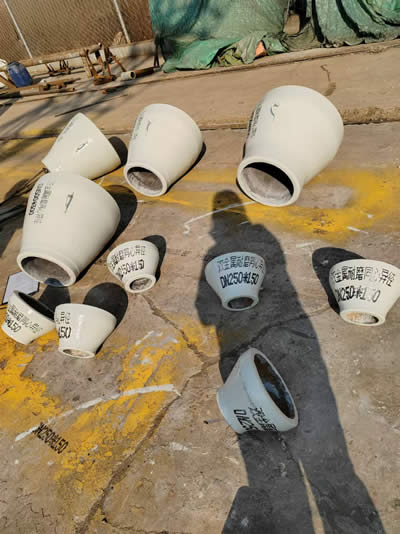
Ceramic-lined pipe is the most cost-effective product for medium and high abrasion working conditions at present. Its inner layer is made of high-purity alumina ceramic (≥95** alumina content), with ultra-high hardness, anti-scouring and anti-corrosion performance. The outer layer adopts carbon steel pipe compliant with ASTM A106 standard, which ensures overall structural strength and welding performance. In actual overseas operation, this material performs best in slurry conveying, coal ash transportation, and mineral tailings discharge systems.
Material Advantages, Shortcomings and Regional Adaptation
In Southeast Asia’s high-temperature, high-humidity, salt-spray coastal mining areas, the ceramic liner is completely immune to humid salt corrosion and acidic mine water, effectively solving the problem of inner wall corrosion and scaling of ordinary steel pipes. The only shortcoming is that the ceramic layer is brittle to strong sharp impact, so it is not suitable for heavy lump ore direct conveying. In the Middle East’s dry and hot desert environment, the carbon steel outer pipe effectively resists strong solar radiation and sand wind abrasion, and the ceramic liner will not deform or fail due to high-temperature thermal expansion. In Japanese and Korean precision industrial projects, the stable material performance fully meets the strict aging resistance and stability requirements of KS D 3562 and JIS G 3459 standards.
Key Performance Parameters Affecting On-Site Operation Efficiency
When evaluating the quality of wear-resistant pipe, we cannot only look at nominal parameters. On-site operating performance such as temperature resistance, pressure resistance, impact resistance and flow pressure loss directly determines the stability and maintenance cycle of the entire pipeline system.
- Temperature and Pressure Resistance: Qualified ceramic-lined pipeline can operate stably for a long time at -20℃ to 350℃, adapting to Middle Eastern extreme high-temperature exposure and Southeast Asian rainy season temperature fluctuations. The standard pressure resistance reaches 1.6–10MPa, meeting the pressure requirements of most mining, power and chemical slurry conveying systems.
- Flow and Anti-Blocking Performance: The inner wall of the ceramic liner is smooth with ultra-low friction coefficient, which effectively reduces pipeline pressure loss and avoids slurry adhesion and scaling. This is particularly critical for Southeast Asian mine slurry conveying with high mud content, which can greatly reduce manual dredging frequency.
- Impact and Wear Resistance: The wear resistance of qualified products is 5–10 times that of ordinary steel pipes. For fine particle slurry and powder conveying in power plants and cement plants, the service life can reach more than 5 years, greatly reducing pipeline replacement frequency.
Overseas B2B Procurement Pitfalls and Regional Customization Rules
After serving overseas industrial buyers for many years, I have summarized a large number of practical procurement avoidance points. Different regional projects have completely different selection and acceptance standards, and universal standard pipes often cannot meet regional special working conditions.
Southeast Asian Project Procurement Focus
Southeast Asia features perennial high temperature, high humidity, coastal salt spray and acidic mine water. Many buyers ignore anti-rust packaging and outer pipe anti-corrosion treatment, resulting in a large number of pipeline outer walls rusting during sea transportation and on-site storage. Engineer’s Reminder: All pipes exported to Southeast Asian coastal projects must adopt double-layer anti-corrosion coating and sealed moisture-proof packaging to avoid salt spray corrosion during long-term sea transportation and on-site stacking. In addition, acidic mine water will corrode ordinary composite liners, so high-purity ceramic lining must be customized.
Middle Eastern Project Procurement Focus
Middle Eastern desert projects face strong solar radiation, frequent sand and dust storms, and large temperature difference between day and night, which easily cause pipeline thermal expansion and contraction, seal aging and sand infiltration. Engineer’s Reminder: For Middle East power and cement plant pipelines, reinforced welding structure and dust-proof sealing gaskets must be customized. Ordinary rubber gaskets will age and fail rapidly under long-term high-temperature exposure, leading to pipeline air leakage and material leakage.
Japanese and Korean Project Procurement Focus
Japan and South Korea have strict industrial standards, compact on-site installation space and mandatory seismic design requirements. Procurement must strictly follow JIS and KS standard dimensions, and the pipeline support and hanger interface needs to reserve seismic installation positions in advance. Random non-standard customization will lead to unqualified project acceptance and delayed construction period.
[Exclusive Extended Section] Hidden Costs & Acceptance Checklist for Overseas Pipeline Projects
Most B2B buyers only calculate the upfront purchase cost of wear-resistant elbow and pipeline, but ignore various hidden costs in acceptance, operation and later maintenance, which is the key reason for low project profit margins. Combining overseas project acceptance experience, I sort out core acceptance items and hidden cost control points.
Key Acceptance Checklist for Cross-Border Pipeline Projects
- Material Inspection: Verify alumina content of ceramic liner (≥95** qualified), outer pipe steel grade compliance with ASTM and JIS standards, and check production ISO 9001 quality certification.
- Structural Acceptance: Check the bonding tightness of liner and outer pipe, no hollowing, no cracking; check welding seam flatness and flange verticality to avoid installation deviation.
- Packaging and Transportation Acceptance: Focus on moisture-proof, dust-proof and anti-collision packaging, especially for sea export projects, to avoid transportation damage and corrosion.
Common Hidden Cost Risks
Unqualified liner bonding quality will cause ceramic layer peeling after 3–6 months of operation, requiring overall pipeline replacement and causing long-term shutdown losses. Non-standard installation size will lead to on-site secondary cutting and transformation, increasing labor and time costs. Unadapted regional anti-corrosion measures will cause outer pipe rust and seal failure, bringing frequent maintenance costs. These hidden costs are far higher than the small savings in upfront procurement.
Conclusion: Optimize Pipeline Selection to Reduce Long-Term Project Costs
In global industrial projects such as mining, power generation, cement and chemical industry, the wear-resistant pipe is a small but core component that determines the stability of the entire material conveying system. Reasonable material selection, regional targeted customization, and standardized acceptance and maintenance can effectively avoid most on-site failures and hidden costs. For Southeast Asian mining slurry projects, corrosion-resistant and moisture-proof customized ceramic-lined pipe is the best choice; for Middle Eastern desert power projects, high-temperature and dust-proof reinforced pipeline structure can ensure long-term stable operation. As a professional wear-resistant pipe supplier in Southeast Asia and the Middle East, we have accumulated rich on-site project experience to provide targeted pipeline solutions for global B2B buyers and project teams.