Field Engineer s Guide to Wear-Resistant Pipe Selection Pitfalls and Regional Application for Global Industrial Projects
Field Engineer’s Guide to Wear-Resistant Pipe: Selection, Pitfalls and Regional Application for Global Industrial Projects
After 12 years of overseeing pipeline installation, commissioning, and maintenance for mining, power plant, and dredging projects across Southeast Asia, the Middle East, and Northeast Asia, I’ve seen countless project delays and unexpected cost overruns caused by incorrect wear-resistant pipe selection and careless on-site application. Most B-side procurement teams only compare basic parameters and unit prices, ignoring regional climate differences and medium abrasion characteristics, which makes even high-spec abrasion-resistant pipe fail to reach its designed service life. In this practical field guide, I’ll share real project experience, break down core selection logic, expose common industry pitfalls, and explain how to match wear-resistant pipeline solutions to local working conditions for global industrial projects.
1. Core Value of Wear-Resistant Pipe in Global Heavy Industrial Scenarios
Unlike ordinary carbon steel pipes that wear out rapidly under high-speed solid-liquid mixed medium impact, wear-resistant pipe is professionally engineered for harsh abrasive working conditions, mainly used for conveying slurry, granular materials, ash slag, and corrosive mixed media in heavy industries. Its core value lies in extending pipeline service life, reducing frequent replacement downtime, and stabilizing long-term project operation efficiency—critical for large-scale continuous production projects.
For Southeast Asian mining and dredging projects, the pipeline system faces persistent threats from high-temperature and high-humidity environments, acidic mine water, and rainy-season high-viscosity mud. Ordinary steel pipes develop pitting corrosion and internal wall abrasion simultaneously, leaking or breaking down within 6–12 months. The customized wear-resistant pipeline effectively resists dual damage from acid corrosion and particle abrasion, adapting to year-round humid and rainy working conditions.
Middle East thermal power and cement plants suffer from extreme dry heat, intense sunlight exposure, and frequent sandstorms. Fine sand particles continuously scour the outer pipe wall and flange gaps, while large temperature differences between day and night cause severe thermal expansion and contraction. Qualified wear-resistant pipe with high-temperature resistant lining avoids lining peeling and seal failure under extreme temperature changes.
In Japan and South Korea’s chemical and aggregate projects, strict on-site construction standards, narrow installation spaces, and seismic design requirements become key assessment indicators. Local projects strictly follow JIS and KS industrial standards, requiring wear-resistant elbow and straight pipe products to achieve precise dimensional tolerance and stable structural seismic performance, different from conventional bulk engineering pipes.
2. Mainstream Wear-Resistant Pipe Material Performance Analysis (Pros & Cons)
Material matching is the core of pipeline abrasion resistance. Many procurement teams only focus on “wear resistance” while ignoring the adaptability of lining and outer pipe materials to regional climates and media, leading to premature failure. I’ve sorted out three mainstream materials used in global projects with clear applicable scenarios.
2.1 Ceramic-Lined Pipe (Alumina Ceramic)
This is the most widely used slurry pipeline in global mining and chemical projects. The inner lining adopts high-purity alumina ceramic, with ultra-high hardness and excellent anti-abrasion performance, 8–10 times the service life of ordinary steel pipes. The outer pipe is usually ASTM A106 seamless steel pipe, balancing pressure resistance and structural stability.
Advantages: Light weight, convenient for transportation and on-site installation, excellent anti-corrosion performance for acidic mine water and chemical slurry, low pipeline pressure loss, and no medium blockage.
Disadvantages: Poor resistance to strong impact; not suitable for conveying large-particle sharp materials for a long time. In ultra-dry and high-temperature environments in the Middle East, long-term direct sunlight may accelerate the aging of the bonding layer if surface anti-ultraviolet coating is missing.
2.2 Bimetallic Composite Wear-Resistant Pipe
It adopts high-chromium alloy wear-resistant inner layer and carbon steel outer tube, with integrated casting and composite forming. It has strong impact resistance and is suitable for harsh working conditions with large particle impact and high material dropping height.
Advantages: Super anti-impact and anti-scour performance, stable in high-temperature working conditions below 600℃, adaptable to dry and dusty working conditions of Middle East cement and coal-fired power plants.
Disadvantages: Heavy weight, high on-site installation requirements, poor corrosion resistance, easy to rust in high-humidity and salt-spray environments in coastal Southeast Asia, requiring enhanced external anti-rust treatment.
2.3 Rubber-Lined Wear-Resistant Pipe
Internal high-elastic rubber lining is mainly used for low-temperature, fine-particle slurry conveying scenarios. It has good anti-abrasion and anti-clogging effects for viscous mud and fine ore slurry.
Advantages: Good buffer performance, low noise, effective prevention of fine material adhesion and pipe blockage, low cost for low-load working conditions.
Disadvantages: Poor high-temperature resistance, unable to adapt to Middle East high-temperature outdoor working conditions; easy aging and peeling in high-salt and high-humidity coastal environments.
3. Overseas Procurement Key Points for Different Regional Projects
One-size-fits-all procurement logic is the biggest taboo for overseas pipeline projects. After years of project docking, I’ve summarized targeted procurement and selection standards for Southeast Asia, Middle East, and Japan-South Korea markets to help procurement teams avoid hidden risks.
3.1 Southeast Asia: Anti-Corrosion and Moisture-Proof Priority
Southeast Asian projects are dominated by mining, dredging, and port aggregate conveying, with typical working conditions of high temperature, high humidity, coastal salt spray, and acidic slurry. First engineer’s pitfall reminder: Do not only pursue high wear resistance while ignoring outer pipe anti-rust treatment. Ordinary painted pipes will suffer salt spray corrosion on the outer wall during maritime transportation and on-site stockpiling, leading to pipe wall thinning and potential safety hazards.
It is recommended to adopt double anti-corrosion treatment of outer pipe epoxy coal tar pitch coating + galvanized layer, and strengthen sealed packaging for maritime transportation to avoid rainwater erosion during long-distance shipping. For acidic mine water slurry pipelines, ceramic-lined pipe is prioritized over bimetallic pipes to prevent inner wall electrochemical corrosion.
3.2 Middle East: High Temperature Resistance and Dust Sealing Priority
Middle East cement, power plant, and metallurgical projects are characterized by dry heat, strong sunlight, frequent sandstorms, and large day-night temperature differences. Pipeline failure is mostly caused by thermal expansion and contraction deformation and dust abrasion of flange seals. Second engineer’s pitfall reminder: Do not use ordinary rubber sealing gaskets for flange connections; high temperature will cause gasket aging and air leakage, and sand dust will enter the connection gap to accelerate local pipeline wear.
Procurement should specify high-temperature resistant fluororubber gaskets, and require outer pipe surface anti-ultraviolet and anti-sand coating treatment. At the same time, reserve a reasonable expansion gap during installation to cope with thermal expansion and contraction of pipelines under 50℃+ extreme high temperature.
3.3 Japan & South Korea: Standard Compliance and Fine Installation Priority
Northeast Asian projects have extremely strict acceptance standards, following JIS G 3459 and KS D 3562 pipeline specifications, with high requirements for pipeline dimensional accuracy, structural stability, and seismic performance. The on-site installation space is narrow, and the project requires standardized seismic support and hanger matching.
When procuring wear-resistant pipe and wear-resistant elbow, full-size dimension inspection reports, ISO 9001 quality certification, and material component test reports must be provided. Non-standard customized sizes need to be pre-verified with on-site construction teams to avoid dimensional errors leading to installation failure.
4. Daily Operation and Maintenance Rules to Extend Pipeline Service Life
High-quality abrasion-resistant pipe can only exert its maximum performance with standardized daily maintenance. Many projects have good pipeline selection in the early stage, but short service life due to irregular maintenance, resulting in repeated investment.
4.1 Regular Inspection and Thickness Detection
For slurry pipeline used for mining and dredging, conduct ultrasonic thickness measurement on vulnerable parts (elbows, tees, variable diameter pipes) every 3 months. In Southeast Asian high-humidity environments, focus on checking outer pipe wall rust and welding seam corrosion; in Middle East projects, check lining peeling and flange seal dust accumulation.
4.2 Timely Cleaning and Blockage Prevention
Viscous mud and fine aggregate slurry are easy to adhere to the pipe wall, resulting in reduced pipe diameter and increased pressure loss. Regular pipeline purging is required according to medium viscosity. For seasonal construction in Southeast Asia, clean residual slurry in the pipeline before the rainy season to avoid pipe blockage caused by mud drying and hardening.
4.3 Standard Replacement and Repair
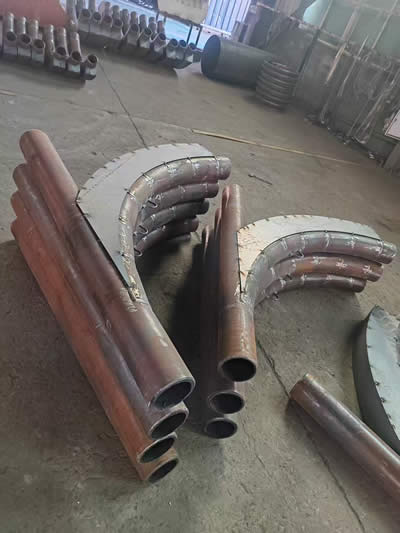
Wear-resistant elbow is the most vulnerable part of the entire pipeline system. When the wall thickness wear exceeds 30** of the original thickness, replace it in time to avoid sudden pipe burst. Local small-area lining damage can be repaired with special wear-resistant repair glue, avoiding overall pipeline replacement and saving project cost.
5. Common High-Frequency Selection Mistakes (Exclusive Extended Section)
In my after-project tracking, more than 60** of pipeline operation failures stem from selection mistakes rather than product quality problems. I’ve sorted out two most typical high-frequency mistakes that overseas B-end procurement and engineering teams often make, with targeted correction schemes.
5.1 Mistake 1: Blindly Pursuing High Hardness, Ignoring Medium Impact Characteristics
Many purchasers equate “high hardness” with “good wear resistance” and blindly choose full ceramic-lined pipes for working conditions with large-particle ore and high-drop impact. In fact, ceramic materials have high hardness but poor toughness. Under long-term strong impact, the inner ceramic layer will crack and peel off in pieces, causing rapid pipeline failure.
Correction Scheme: For large-particle ore conveying in mines, prioritize bimetallic composite wear-resistant pipe with strong impact resistance; for fine-particle slurry and corrosive media, choose ceramic-lined pipe to give full play to its anti-abrasion and anti-corrosion advantages.
5.2 Mistake 2: Uniform Model Selection, Ignoring Regional Climate Adaptability
Many international trading companies use a unified product model to supply Southeast Asia, Middle East, and Northeast Asian projects, which is a typical irresponsible operation. The same wear-resistant pipeline will have completely different service life in different climates.
Correction Scheme: Match product configurations according to regional characteristics: increase anti-salt spray and anti-corrosion coating for Southeast Asian coastal projects; upgrade high-temperature resistant lining and anti-UV outer coating for Middle East outdoor projects; strictly calibrate dimensional accuracy and standard compliance for Japan-South Korea standardized projects.
6. Comprehensive Summary of Global Wear-Resistant Pipeline Project Application
To sum up, the selection and application of wear-resistant pipe for overseas industrial projects is a systematic work integrating material performance, regional working conditions, project standards, and daily maintenance. There is no universal best product, only the most matched solution. Ceramic-lined pipe is the optimal choice for corrosive fine slurry working conditions in Southeast Asia; bimetallic composite pipes are more suitable for high-temperature and high-impact scenarios in the Middle East; high-precision standardized customized pipelines meet the strict acceptance requirements of Japan and South Korea markets.
For global B-end purchasers and project managers, the core of cost control is to avoid blind low-price procurement and one-size-fits-all selection. Combining regional climate characteristics, medium abrasion degree, and project certification standards to select targeted abrasion-resistant pipe and supporting wear-resistant elbow can fundamentally reduce later maintenance and replacement costs. As a professional wear-resistant pipe supplier in Southeast Asia and the Middle East, we have accumulated rich on-site project experience to provide customized pipeline solutions for global mining, power, cement, and dredging projects.