Field Engineer s Guide to Wear-Resistant Pipe Material Selection Regional Adaptation and Common Sourcing Mistakes
Field Engineer’s Guide to Wear-Resistant Pipe: Material Selection, Regional Adaptation and Common Sourcing Mistakes
After 12 years of overseeing pipeline installation, commissioning, and replacement projects across Southeast Asia, the Middle East, and Northeast Asia, I’ve seen countless B2B procurement teams and project engineers pick the wrong wear-resistant pipe for their site conditions. More often than not, failures are not caused by poor product quality, but by mismatched material selection, ignored regional climate traits, and generic purchasing habits. On mining slurry lines, cement clinker conveying systems, and power plant ash removal pipelines, a minor wrong choice leads to frequent shutdowns, unplanned maintenance costs, and shortened pipeline service life. This practical guide shares on-site experience, regional adaptation rules, and typical selection mistakes to help overseas project teams make cost-effective and durable pipeline decisions.
1. Core Application Value of Wear-Resistant Pipe in Heavy Industrial Projects
A wear-resistant pipe is a specialized pipeline component designed to resist particle abrasion, slurry impact, and medium corrosion in harsh industrial working conditions, different from ordinary carbon steel and stainless steel pipelines. Its core value lies in solving the two biggest pain points of industrial fluid conveying: rapid wall thinning caused by solid particle scouring and frequent pipeline blockage in high-concentration slurry transportation. For cross-border industrial projects, stable pipeline operation directly determines project productivity and long-term operational costs.
In Southeast Asian mining and dredging projects, high-temperature and high-humidity environments paired with acidic mine water and rainy season mud slurry severely erode ordinary steel pipelines. Traditional pipes need replacement every 6–12 months, while qualified abrasion-resistant pipe can extend service life by 5–8 times. In Middle Eastern cement and mining sites, strong solar radiation and continuous sand dust erosion wear down pipeline outer walls and flange sealing structures, making wear-resistant pipeline systems with anti-aging and dust-proof designs essential for stable operation. For Japanese and Korean power and chemical projects, strict operational standards and compact installation spaces require wear-resistant elbow and straight pipe products with precise dimensional tolerance and stable structural performance to meet frequent refined inspection and maintenance requirements.
2. Mainstream Wear-Resistant Pipeline Material Performance Analysis (Pros & Cons)
After participating in over 80 overseas industrial pipeline projects, I’ve summarized the actual on-site performance of five mainstream wear-resistant pipeline materials. No single material is universal; the best choice depends on medium composition, temperature, impact strength, and regional climate conditions.
2.1 Ceramic-Lined Pipe
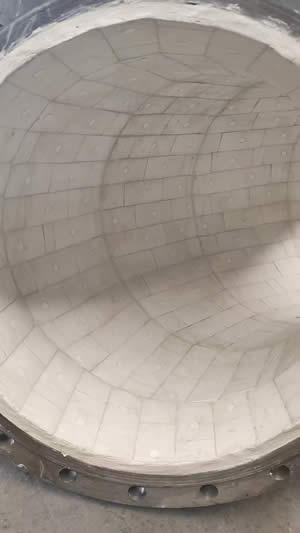
Ceramic-lined pipe is the most widely used slurry pipeline for fine particle and medium-speed conveying scenarios. Its inner alumina ceramic layer features ultra-high hardness, excellent anti-abrasion performance, and smooth inner wall that effectively prevents scaling and blockage. The outer carbon steel pipe ensures overall structural strength and welding convenience. However, its obvious shortcoming is poor resistance to strong mechanical impact; severe impact from large-diameter ore particles will cause ceramic layer peeling and cracking. It is highly suitable for Southeast Asian dredging slurry lines and chemical wastewater conveying, but not recommended for Middle Eastern open-pit mining coarse ore conveying with frequent heavy impact.
2.2 Double-Metal Composite Pipe
This pipe adopts high-chromium cast iron wear-resistant inner layer and carbon steel outer tube composite structure. It balances impact resistance and wear resistance perfectly, with strong adaptability to high-impact, large-particle conveying working conditions. It can withstand high temperature up to 350°C and is resistant to dry heat aging. The downside is higher cost and slightly larger pipeline friction loss compared with ceramic-lined pipe. It is the preferred choice for Middle Eastern dry sand and gravel aggregate conveying lines and high-temperature power plant ash pipelines.
2.3 Surfacing Wear-Resistant Pipe
With a surfacing alloy wear-resistant layer on the inner wall, this product features adjustable wear layer thickness and flexible customization. It performs well in irregular abrasion working conditions and has strong welding reparability on site. Its limitation is unstable wear resistance uniformity, making it unsuitable for long-distance fixed slurry conveying. It is often used for local reinforcement and replacement of vulnerable pipe sections in Japanese and Korean steel metallurgy projects.
2.4 Rubber Lined & Polymer Lined Pipe
Rubber and polymer lined pipes have excellent corrosion resistance and anti-blocking performance, suitable for acidic and alkaline chemical medium conveying. Their fatal weakness is poor high-temperature resistance; they will age and deform rapidly under long-term sunlight exposure and high temperature above 80°C. They are only applicable for indoor low-temperature chemical pipelines, completely unsuitable for outdoor open-air layouts in the Middle East and tropical Southeast Asia.
3. Structural Design & Internal Working Principle of Industrial Wear-Resistant Pipeline
Many procurement teams only focus on surface material parameters while ignoring internal structural design, which is the core reason for pipeline early failure. A standard qualified wear-resistant pipeline consists of four core parts: outer protective pipe, composite wear-resistant inner layer, bonding transition layer, and standardized connecting structure. Each structure plays an irreplaceable role in different regional working conditions.
3.1 Multi-Layer Composite Structure Design
The outer pipe is usually made of ASTM A106 or API 5L carbon steel, ensuring overall pressure bearing capacity, structural rigidity, and convenient on-site welding. The middle transition bonding layer fixes the inner wear-resistant layer to avoid layer separation caused by thermal expansion and contraction. The inner wear-resistant layer undertakes all medium scouring and abrasion. In Middle Eastern dry and hot environments, temperature difference between day and night exceeds 30°C for a long time; pipelines without high-elasticity transition layers are prone to inner layer peeling due to repeated thermal expansion and cold contraction. In Southeast Asian high-humidity and salt-spray environments, the transition layer also needs anti-corrosion glue coating to prevent internal rusting from spreading outward.
3.2 Pipeline Connection Structure Adaptability
Common connection methods include welding, flange connection, and clamp connection. Welding connection is suitable for long-distance fixed pipelines with high overall stability, widely used in Southeast Asian mining slurry lines. Flange connection is convenient for disassembly and maintenance, matching the refined maintenance mode of Japanese and Korean projects, and complies with JIS G 3459 and KS D 3562 standard flange dimensions. In Middle Eastern dusty environments, flange connections must be equipped with dust-proof and high-temperature resistant sealing gaskets; otherwise, sand and dust will invade the joint gap, causing medium leakage and accelerated local wear.
4. Overseas Procurement Key Points for Southeast Asia, Middle East and Japan-Korea Projects
After years of serving overseas B2B project procurement, I find that universal pipeline procurement schemes never work. Different regions have completely different climate, working conditions, and acceptance standards, and targeted selection and procurement strategies must be adopted.
4.1 Southeast Asia High-Humidity Mining & Dredging Projects
Southeast Asia features perennial high temperature, high humidity, severe salt spray corrosion, and rainy season high-concentration mud slurry impact. Engineer’s Pitfall Reminder: Never use ordinary uncoated wear-resistant pipe for marine transportation and outdoor pipe layout. Sea transportation for 20–30 days will cause outer pipe salt spray rust, and on-site secondary polishing and anti-rust treatment will delay the construction period. It is necessary to specify factory outer wall anti-corrosion coating and vacuum packaging in the procurement contract. In addition, acidic mine water in local mines requires wear-resistant inner layers with acid corrosion resistance; ordinary high-chromium cast iron layers will accelerate corrosion in acidic media.
4.2 Middle East Dry Heat & Dust Industrial Projects
Middle Eastern projects face extreme dry heat, strong sunlight exposure, and continuous sand dust scouring. Pipeline failure is mostly caused by outer wall aging, flange sealing failure, and thermal expansion and contraction deformation. Engineer’s Pitfall Reminder: Do not prioritize low-price thin-walled wear-resistant pipeline products. Long-term sunlight ultraviolet radiation will age the outer pipe paint, and sand dust persistent scouring will thin the outer wall rapidly. Procurement must confirm outer pipe wall thickness tolerance and ultraviolet aging resistance parameters. Meanwhile, reserved expansion joints must be increased in pipeline design to cope with large temperature difference deformation and avoid pipeline cracking.
4.3 Japan & Korea Refined Industrial Projects
Japanese and Korean power, chemical, and metallurgical projects feature narrow installation space, strict seismic requirements, and ultra-strict acceptance standards. All pipeline products must comply with local JIS and KS industry standards, with full dimensional parameter traceability. On-site installation requires matching seismic support and hanger systems, and the pipeline allowable error range is far lower than international general standards. Procurement must require suppliers to provide full factory inspection reports, material certification, and standard dimension detection data; unqualified products will be directly rejected on site.
5. Daily Operation & Maintenance Rules to Extend Pipeline Service Life
Even the best wear-resistant pipeline will fail prematurely without standardized maintenance. Combined with overseas on-site operation experience, targeted maintenance strategies for different regional working conditions are summarized below.
For Southeast Asian rainy season working conditions, regular pipeline blockage inspection and cleaning are required. High-viscosity mud slurry is easy to adhere to the inner wall, leading to reduced flow rate and increased local abrasion. Monthly inner wall cleaning and thickness detection of wear-resistant elbow (the most vulnerable part) are necessary. For Middle Eastern projects, regular inspection of flange sealing strips and outer wall anti-corrosion coating is essential; damaged sealing strips should be replaced in time to prevent dust invasion and leakage. For Japanese and Korean projects, regular seismic support fastening and precise thickness measurement of pipeline vulnerable sections are required to meet daily refined operation and inspection standards.
In addition, pipeline storage management cannot be ignored. In high-humidity areas, pipelines must be placed in ventilated warehouses with moisture-proof pads to avoid ground moisture corrosion. In windy and sandy Middle Eastern areas, covered storage is required to prevent sand and dust from adhering to the pipe mouth and entering the pipeline during installation.
6. Exclusive Guide: High-Frequency Wear-Resistant Pipeline Selection Mistakes (Engineer On-Site Summary)
After sorting out hundreds of overseas pipeline failure cases in recent years, I have summarized three most common selection mistakes of B-end procurement and project teams, which are also the main causes of project cost overrun and delayed construction.
6.1 Mistake 1: Blindly Pursuing High Hardness While Ignoring Working Condition Adaptation
Many purchasers equate high hardness with good wear resistance and blindly choose ultra-high hardness ceramic-lined pipe for all working conditions. In fact, ceramic-lined pipe is not suitable for heavy impact working conditions such as coarse ore conveying and large-particle gravel aggregate transportation. On Middle Eastern open-pit mining sites, many projects have ceramic layer peeling and pipeline scrapping within 3 months of use due to wrong selection. Hardness and impact resistance must be matched with actual conveying medium particle size and impact strength.
6.2 Mistake 2: Ignoring Regional Climate Differences and Adopting Universal Selection Scheme
The same pipeline model has completely different service life in different regions. Rubber-lined pipes with good performance in temperate zones will age rapidly and fail in Southeast Asian high-temperature and high-humidity environments and Middle Eastern strong sunlight environments. Ordinary carbon steel outer pipes without anti-corrosion treatment will rust and penetrate in half a year in coastal salt spray areas. Selection must take the local temperature, humidity, salt spray, sand and dust climate characteristics into comprehensive consideration, instead of copying indoor working condition schemes.
6.3 Mistake 3: Only Comparing Unit Price, Ignoring Overall Project Comprehensive Cost
Low-cost ordinary wear-resistant pipeline seems to save initial procurement cost, but it has short service life, frequent shutdown replacement, and high maintenance cost. For long-term operation projects, high-quality composite wear-resistant pipeline with 3–5 times service life can greatly reduce later maintenance and replacement cost, which is the real cost-effective choice.
7. Conclusion
Selecting a suitable wear-resistant pipe for overseas industrial projects is a systematic work that needs to comprehensively consider material performance, structural design, regional working conditions, and later maintenance. Ceramic-lined pipe, double-metal composite pipe, and surfacing wear-resistant pipe have their own applicable scenarios, and targeted selection must be made combined with Southeast Asian high-humidity acid working conditions, Middle Eastern dry heat dust environment, and Japan-Korea refined standard requirements. Avoiding common selection mistakes and doing a good job in regional adaptive procurement and daily maintenance can maximize the service life of abrasion-resistant pipe and stabilize the operation of slurry pipeline systems. For Middle East mining and Southeast Asian dredging project teams, choosing a professional wear-resistant pipe supplier in Southeast Asia with rich overseas project experience is the key to avoiding on-site risks and reducing comprehensive project costs.