Field Engineer s Guide to Wear-Resistant Pipe Regional Adaptation Material Selection amp Cost-Effective Procurement
Field Engineer’s Guide to Wear-Resistant Pipe: Regional Adaptation, Material Selection & Cost-Effective Procurement
After 12 years of overseeing pipeline installation, troubleshooting, and procurement optimization for mining, power plant, cement, and dredging projects across Southeast Asia, the Middle East, and Northeast Asia, I’ve seen countless project delays and budget overruns caused by incorrect wear-resistant pipe selection and careless bulk purchasing. Most B-side project managers and procurement teams focus only on initial pipe prices, ignoring regional climate traits, medium abrasiveness, and long-term operational costs. This practical guide breaks down real-field selection logic, regional adaptation rules, and cost-saving procurement strategies for abrasion-resistant pipe systems, tailored specifically for overseas industrial projects.
1. Core Functions & Real-World Industrial Value of Wear-Resistant Pipe
A wear-resistant pipe is a specialized industrial pipeline component designed to mitigate material loss caused by high-speed solid particle impact, slurry friction, and chemical medium erosion, serving as the core transportation carrier for abrasive media in heavy industrial projects. Unlike ordinary carbon steel pipes that fail rapidly under harsh working conditions, qualified wear-resistant pipeline maintains stable structural performance during long-term delivery of ore slurry, cement clinker, coal ash, sand aggregate, and chemical mixed materials.
In actual overseas project delivery, its practical value varies significantly by industry. For Southeast Asian river dredging and port sand aggregate projects, these pipes resist continuous friction from high-concentration sediment slurry in rainy seasons, avoiding frequent pipe rupture and construction halts. For Middle Eastern thermal power and metallurgical plants, they withstand persistent dry sand abrasion and extreme temperature changes. For Japanese and Korean chemical and power projects, high-precision wear-resistant elbow and straight pipe combinations meet strict standardized operation and low-maintenance requirements of refined industrial systems.
Engineer’s Field Reminder 1: Never replace professional slurry pipeline with thickened ordinary steel pipes for cost savings. On-site data shows thickened carbon steel pipes need replacement every 3–6 months in Southeast Asian rainy-season slurry working conditions, while standard ceramic-lined pipe can operate stably for 3–5 years, eliminating frequent shutdown losses.
2. Mainstream Wear-Resistant Pipe Material Analysis: Pros, Cons & Regional Application Matching
Material selection is the core of pipeline system stability. I’ve summarized the three most widely used wear-resistant pipe materials for overseas projects, combining regional climate and working condition characteristics to clarify their applicable scenarios, avoiding one-size-fits-all selection mistakes.
2.1 Ceramic-Lined Composite Material
This is the most cost-effective mainstream material for current overseas industrial projects. The inner layer adopts high-purity alumina ceramic wear layer, and the outer layer is ordinary carbon steel pipe. The ceramic layer features high hardness, strong abrasion resistance, and excellent anti-scaling performance, while the outer steel pipe ensures overall structural toughness and welding convenience. Its biggest advantage is strong adaptability to fine particle slurry and high-flow abrasive media, making it ideal for cement plant clinker conveying, chemical slurry transportation, and port dredging projects.
Regionally, ceramic-lined pipe performs exceptionally well in Southeast Asia’s high-temperature, high-humidity, salt-spray environments. The dense ceramic inner layer completely isolates acidic mine water and salt spray corrosion, while the outer steel pipe can be protected with enhanced anti-rust coating to resist coastal humid corrosion. Its only shortcoming is poor resistance to violent heavy particle impact, so it is not recommended for large-particle ore primary conveying in mines.
2.2 High-Chromium Alloy Wear-Resistant Material
High-chromium alloy pipe integrates wear resistance and impact resistance, with an integral alloy wear layer that avoids peeling and delamination. It is mainly suitable for working conditions with large solid particles and strong impact force, such as mine raw ore conveying and coal washing plant slag transportation. In Middle Eastern desert mining projects, this material effectively resists frequent impact and abrasion of large sand and gravel particles caused by strong wind and sand.
The downside is obvious: high-chromium alloy materials have poor high-temperature thermal stability and are prone to thermal expansion deformation under long-term Middle Eastern extreme sun exposure (ambient temperature above 50°C). Therefore, for outdoor exposed pipeline layouts in the Middle East, supplementary heat insulation and sunshade measures must be added.
2.3 Rubber-Lined Wear-Resistant Material
Rubber-lined pipe relies on high-elastic rubber lining to buffer medium friction and impact, with excellent anti-corrosion and anti-blocking effects, suitable for low-temperature, fine-particle, and corrosive chemical media. It is widely used in Japanese and Korean fine chemical projects. These regions have strict requirements for pipeline noise reduction and medium protection, and the rubber lining can avoid metal contamination of chemical raw materials.
Engineer’s Field Reminder 2: Rubber-lined pipelines are strictly prohibited for outdoor use in the Middle East. Long-term high-temperature exposure will cause rubber aging, cracking, and peeling within half a year, leading to complete pipeline failure.
3. Full Category Classification & Scenario-Adaptive Selection Rules
Wear-resistant pipeline systems are not limited to straight pipes; complete supporting pipe fittings determine the overall operational stability of the project. Based on structural form and connection mode, I classify common products and match them with overseas regional working conditions, helping teams complete accurate one-stop selection.
3.1 Classification by Pipe Fitting Structure
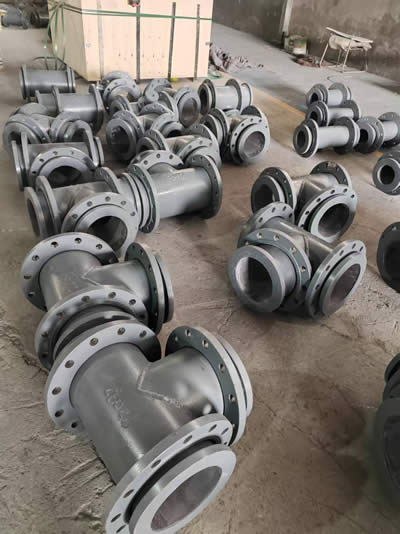
Conventional supporting products include straight pipes, wear-resistant elbows, tees, reducers, and special-shaped pipe fittings. Among them, elbows are the most vulnerable parts of the entire pipeline system, as medium impact and friction are concentrated at the bending position. In Southeast Asian dredging projects, the elbow loss rate is 3–5 times that of straight pipes, so local thickened ceramic-lined elbows must be used instead of ordinary straight pipe bending parts.
Tees are mainly used for shunting and converging of ore slurry and ash materials. For Middle Eastern power plant ash conveying pipelines, reinforced integrated tees are recommended to avoid local abrasion and perforation caused by long-term concentrated material scouring.
3.2 Classification by Connection Mode
Three mainstream connection modes cover all overseas project standards: welding, flange connection, and clamp connection. Welding connection is suitable for fixed pipe galleries of large mines and power plants, with high overall stability and low leakage risk. Flange connection is widely used in Middle Eastern outdoor pipelines; the sealed flange structure can effectively block desert sand from entering the pipeline gap and avoid internal pipeline abrasion caused by sand accumulation.
Clamp connection is the first choice for Japanese and Korean projects with narrow installation space. It features fast assembly, no complex welding construction, and convenient later maintenance and replacement, fully adapting to the compact equipment layout characteristics of Northeast Asian refined industrial projects, and meets JIS G 3459 pipeline installation standard requirements.
4. Overseas Procurement Key Points: Regional Standard & Working Condition Avoidance Strategies
B2B bulk procurement of wear-resistant pipe for overseas projects is far more complicated than domestic purchasing. Different regions have clear differences in standard specifications, climatic adaptation requirements, and acceptance standards. Blind universal procurement will lead to unqualified on-site installation and rework losses.
4.1 Southeast Asia Procurement Focus
Southeast Asian projects are dominated by high humidity, coastal salt spray, and rainy season mud slurry working conditions. Procurement must focus on two core points: enhanced outer pipe anti-rust treatment and strict marine packaging standards. Ordinary paint coating will fail during long-term sea transportation, leading to outer pipe rust and affecting on-site use. It is necessary to customize multi-layer anti-corrosion coating and sealed wooden box packaging to avoid marine moisture erosion. In addition, for acidic mine water conveying pipelines, the wear-resistant lining must meet ISO 9001 anti-corrosion performance standards to resist medium acid corrosion.
4.2 Middle East Procurement Focus
Middle Eastern desert working conditions are characterized by extreme dry heat, strong sun exposure, and frequent sandstorms. Procurement priority is given to high-temperature resistant and dust-sealed pipeline products. All flange accessories must be equipped with high-temperature resistant sealing gaskets to prevent dust from entering the pipeline gap and causing secondary abrasion. At the same time, pipeline thermal expansion and contraction coefficients must be considered, and products with stable structural tolerance should be selected to avoid pipeline cracking caused by extreme temperature difference between day and night.
4.3 Japan & Korea Procurement Focus
Northeast Asian projects pursue refined management and strict standardization. Procured abrasion-resistant pipe must strictly comply with JIS and KS industry standards, with complete factory inspection reports and dimensional tolerance data. In addition, projects in this region have mandatory requirements for seismic performance; supporting seismic brackets and fixed parts must be matched during procurement to meet local building seismic specifications. The acceptance process is extremely strict, and any deviation in pipe wall thickness, lining uniformity, and dimensional accuracy will lead to unqualified acceptance.
5. Daily Operation & Maintenance Strategy for Overseas Pipeline Systems
Good maintenance can double the service life of wear-resistant pipeline systems and reduce long-term project operation costs. Combined with the low on-site maintenance efficiency of overseas projects and regional environmental characteristics, I have sorted out targeted daily maintenance specifications.
5.1 Regular Inspection & Thickness Detection
For Southeast Asian projects, regular thickness detection of pipeline elbows and tee vulnerable parts is required every 3 months. High humidity environment is prone to outer pipe corrosion and inner lining wear synchronization, and early detection of thin-wall deformation can avoid sudden pipe burst accidents. For Middle Eastern outdoor pipelines, it is necessary to regularly clean the surface dust and check flange sealing integrity to prevent sand accumulation and accelerated local wear.
5.2 Seasonal Maintenance & Storage Management
During the rainy season in Southeast Asia, idle pipelines need to be drained and sealed to avoid long-term immersion of slurry residue leading to pipeline scaling and internal corrosion. Middle Eastern summer maintenance focuses on sunshade and heat insulation of exposed pipelines to reduce thermal aging of pipeline structural layers. For Japanese and Korean projects with high equipment precision requirements, regular bolt fastening and bracket calibration are needed to ensure stable pipeline operation and avoid vibration wear caused by equipment operation.
5.3 Fault Prevention & Local Replacement Rules
Do not perform arbitrary welding and repair on worn pipelines. Ceramic-lined pipe is prone to lining peeling after unstandardized welding. It is recommended to reserve 5**–10** of vulnerable pipe fittings (mainly wear-resistant elbows) during procurement for emergency replacement, which can greatly shorten on-site maintenance downtime.
6. Exclusive Guide: B2B Procurement Cost-Performance Optimization & Hidden Cost Control
Most overseas B-end buyers only compare the unit price of wear-resistant pipe in the procurement stage, ignoring a series of hidden costs such as transportation loss, installation difficulty, maintenance frequency, and regional adaptation failure. Based on years of overseas project cost accounting experience, this section shares exclusive procurement cost control strategies to help teams achieve low-cost and high-efficiency pipeline system deployment.
6.1 Short-Term Procurement Cost Optimization Rules
Short-term cost control does not mean choosing the lowest-priced products, but matching the most cost-effective materials according to regional working conditions. For general slurry conveying projects in Southeast Asian ports and sand and gravel plants, conventional ceramic-lined pipe is the best choice, with moderate unit price and excellent abrasion resistance, avoiding the waste of high-alloy high-cost materials. For Middle Eastern desert mining projects with severe particle impact, high-chromium alloy pipe is preferred. Although the initial procurement cost is higher, it can reduce 80** of replacement frequency and save a lot of shutdown and labor costs.
In addition, centralized bulk procurement of supporting pipe fittings can reduce customized single-piece processing fees. Matching complete elbows, tees, and reducers in one order can also avoid additional logistics costs caused by subsequent supplementary procurement.
6.2 Long-Term Hidden Cost Avoidance Mechanism
The biggest hidden cost of overseas pipeline projects is unqualified regional adaptation and frequent maintenance replacement. Many buyers choose cheap ordinary abrasion-resistant pipe to compress budget, but the service life is less than one year in harsh overseas working conditions. The repeated procurement, transportation, and installation costs far exceed the initial price difference of products.
Another easily ignored hidden cost is marine transportation damage. Non-standard packaging will cause lining cracking and pipe body deformation during long-distance sea transportation. For cross-border procurement, it is necessary to require suppliers to provide professional seaworthy packaging and complete cargo insurance, which can effectively control transportation loss costs. For long-term cooperative projects in Southeast Asia, choosing a professional wear-resistant pipe supplier in Southeast Asia with local delivery warehouses can greatly shorten the delivery cycle and avoid project delay penalties caused by long transportation cycles.
7. Conclusion
The selection, procurement, and maintenance of wear-resistant pipe for overseas industrial projects is a systematic project that needs to combine regional climate characteristics, medium working conditions, industry standards, and full-cycle cost control. Blindly relying on experience or low-price procurement will inevitably bring hidden dangers to project operation. From material selection, category matching, regional standardized procurement to daily refined maintenance, every link determines the service life and operational efficiency of the abrasion-resistant pipe system. For mining, power, cement, and dredging projects in Southeast Asia, the Middle East, and Japan-Korea regions, targeted customized selection and full-cycle cost management are the core of maximizing project benefits. Choosing adaptive wear-resistant pipeline products and standardized procurement and maintenance schemes is the key to stable and long-term operation of overseas industrial pipeline systems.