Wear-Resistant Pipe Selection amp Global Project Application Guide for Mining Cement and Aggregate Projects
Wear-Resistant Pipe Selection & Global Project Application Guide for Mining, Cement and Aggregate Projects
After 12 years of field service on mining, cement, and sand and gravel aggregate projects across Southeast Asia, the Middle East, and Japan & South Korea, I’ve seen countless pipeline failures that have nothing to do with product quality itself. Most onsite downtime, budget overruns, and frequent replacement issues stem from incorrect wear-resistant pipe selection, mismatched material adaptation, and ignored regional climatic working conditions. As a pipeline engineer and B2B procurement consultant focusing on overseas industrial projects, I’ve summarized practical, project-tested experience to help project managers and procurement teams avoid common pitfalls when sourcing abrasion-resistant pipe and designing wear-resistant pipeline systems for global industrial facilities.
1. Core Value of Wear-Resistant Pipe in Global Industrial Scenarios
Unlike ordinary seamless steel pipes that only bear basic fluid transmission pressure, professional wear-resistant pipe is engineered to solve high-frequency abrasion, impact, and medium corrosion problems in harsh industrial working conditions. It serves as the core component of slurry pipeline systems for solid-liquid mixed material transmission, covering mainstream high-abrasion scenarios including mine ore slurry transportation, cement clinker conveying, sand and gravel aggregate feeding, and industrial ash slag discharge.
In overseas project delivery, the core value of this pipeline is reflected in long-term stable operation and reduced overall project costs. For large-scale continuous production projects, frequent pipeline leakage, wall thinning, and pipe burst failures will lead to production halts, labor maintenance costs, and delayed project acceptance. A properly selected wear-resistant pipe can extend the service life of conveying pipelines by 5–10 times compared with traditional steel pipes, which is the key reason why mainstream overseas industrial projects gradually eliminate ordinary pipe solutions.
Combined with regional working conditions, the scenario advantages are more obvious. In Southeast Asian aggregate and mining projects, high-temperature and high-humidity environments paired with acidic mine water and rainy season muddy slurry cause dual abrasion and electrochemical corrosion on pipeline inner walls. Ordinary steel pipes fail in 3–6 months, while customized wear-resistant pipelines can operate stably for more than 3 years. In Middle Eastern desert sand and gravel projects, strong wind and sand cause persistent particle scouring on outdoor pipelines, and extreme day-night temperature differences lead to frequent thermal expansion and contraction of conventional pipes. In Japan and South Korea’s refined industrial projects, compact factory space and frequent seismic tests require pipelines to balance wear resistance, structural stability and installation adaptability.
2. Mainstream Wear-Resistant Pipeline Material Performance Analysis & Scenario Adaptation
Many B-end buyers only focus on price when purchasing wear-resistant elbow and straight pipes, ignoring the performance differences of different wear-resistant materials, which leads to serious over-design or insufficient service life. Based on onsite project verification, I sort out the advantages, shortcomings and applicable regional working conditions of several mainstream materials for overseas projects.
2.1 Ceramic-Lined Pipe
Ceramic-lined pipe is the most widely used abrasion-resistant pipe in medium and fine particle slurry transmission scenarios. Its inner lining is made of high-purity alumina ceramic layer, with ultra-high hardness and anti-abrasion performance, while the outer carbon steel pipe ensures overall structural strength. The biggest advantage is light weight and low pipeline pressure loss, which is very suitable for long-distance slurry transmission in aggregate and cement projects.
Engineer’s Pitfall Reminder 1: Ceramic-lined pipes are not suitable for high-impact bulk material transmission. In Middle Eastern large-particle ore conveying projects, direct impact of bulk sand and gravel will cause ceramic lining peeling and cracking. In addition, this material is not resistant to rapid temperature alternating, so it needs strict heat preservation and dust-sealing protection for outdoor exposure in Middle Eastern extreme hot sun environments.
2.2 Dual-Metal Wear-Resistant Pipe
Dual-metal composite pipe adopts high-chromium alloy wear-resistant inner layer and carbon steel outer tube, with strong impact resistance and high-temperature resistance. It is the preferred material for heavy-duty working conditions such as large-particle ore transportation and high-temperature clinker conveying in cement plants. It can withstand strong particle impact and high-pressure scouring, and has good adaptability to dry and hot desert working conditions in the Middle East.
The disadvantage is that the self-weight is larger than ceramic-lined pipes, and the pipeline pressure loss is slightly higher. In Southeast Asian rainy season high-humidity and salt spray environments, the weld joints of dual-metal pipes are prone to local corrosion if the anti-rust coating is not constructed in place during shipment and installation.
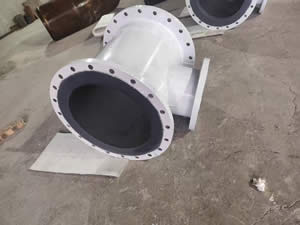
2.3 Rubber Lined Wear-Resistant Pipe
Rubber lined pipelines rely on high-elastic polymer rubber lining to buffer particle impact and resist slurry abrasion. They are excellent in anti-corrosion and anti-cavitation performance, and are very suitable for acidic mine water and corrosive slurry working conditions in Southeast Asian mines. The flexible lining can effectively reduce pipeline blockage caused by material adhesion.
Engineer’s Pitfall Reminder 2: Rubber lined pipes have strict temperature limits and cannot be used in high-temperature scenarios above 80℃. They are completely unsuitable for open-air installation in the Middle East, where surface temperatures exceed 60℃ in summer, which will cause rubber aging, hardening and rapid failure.
3. Overseas Procurement Guidelines: Regional Working Condition Adaptation & Standard Compliance
Procuring wear-resistant pipe for overseas projects cannot follow a unified domestic standard. Different regions have unique climatic environments, industry standards and project acceptance requirements. Blind universal procurement will lead to unqualified on-site installation and failed acceptance. I have sorted out targeted procurement key points for Southeast Asia, Middle East, Japan and South Korea based on years of project experience.
3.1 Southeast Asia: High Humidity, Salt Spray and Acid Slurry Adaptation
Southeast Asian mining and aggregate projects are dominated by tropical rainforest climate, with perennial high temperature, high humidity and coastal salt spray erosion. The core procurement focus is anti-corrosion and anti-slurry blockage. First, the outer wall of the pipeline must adopt enhanced anti-rust and anti-corrosion coating to avoid container sea transportation and on-site pipe rack support corrosion. Second, for acidic mine water slurry working conditions, priority should be given to rubber lined or ceramic-lined pipe with acid-resistant treatment, and ordinary high-chromium cast iron pipes are prohibited to be used alone. In addition, rainy season mud has high viscosity, and the pipeline inner wall needs smooth treatment to reduce material adhesion and blockage probability.
3.2 Middle East: Dry Heat, Sand Erosion and Thermal Expansion Control
Middle Eastern projects are faced with desert dry heat, strong sand wind scouring and extreme temperature differences. The pipeline system must solve three core problems: sand abrasion resistance, thermal expansion displacement and flange dust sealing. When purchasing, prioritize dual-metal wear-resistant pipes with high temperature resistance and strong impact resistance. All flange connections must be equipped with high-temperature dust-proof sealing gaskets to prevent sand from invading the joint gap and causing pipeline leakage. At the same time, reserve sufficient expansion joints for the pipeline to avoid pipe body deformation and weld cracking caused by thermal expansion and contraction under extreme temperature differences.
3.3 Japan & South Korea: Refined Construction, Standard Compliance and Seismic Adaptation
Japanese and South Korean industrial projects feature refined management, strict acceptance standards and compact installation space. All wear-resistant pipeline products must comply with JIS G 3459 and KS D 3562 industry standards, and complete material inspection reports and factory certification documents are mandatory. On-site installation space is narrow, so non-standard fixed-size pipelines and integrated wear-resistant elbow components are often required. In addition, the pipeline support system must adopt professional seismic supports to meet local seismic design specifications, which is a key inspection item for project final acceptance.
4. Daily Operation Maintenance & Common On-Site Troubleshooting
Good selection and procurement are the foundation, and standardized daily maintenance is the key to extending the service life of wear-resistant pipeline systems. Most overseas project teams have insufficient professional pipeline maintenance experience, leading to premature failure of qualified products. Below are practical maintenance and troubleshooting methods suitable for global projects.
4.1 Routine Inspection and Daily Maintenance Specifications
For all slurry pipeline systems, regular wall thickness measurement is the core inspection item. It is recommended to use ultrasonic thickness gauges to detect the wall thickness of vulnerable parts such as wear-resistant elbow, tee and variable diameter pipe every month, and make data records to form a wear trend report. For Southeast Asian projects, regular derusting and supplementary coating of pipeline outer walls and supports are required to resist salt spray corrosion. For Middle Eastern outdoor pipelines, regularly check the tightness of flange seals and clean accumulated sand around the pipeline to avoid long-term sand burying and local overheating.
In terms of storage and protection, pipelines stored in open yards for a long time must be covered with rainproof and sunshade cloths. Especially in the Middle East strong sunlight environment, long-term direct exposure will accelerate the aging of composite pipeline bonding layers and reduce structural stability.
4.2 Common On-Site Fault Troubleshooting
Pipeline blockage and local leakage are the two most common faults in aggregate and mining slurry transportation. For viscous slurry blockage in Southeast Asian rainy seasons, high-pressure water flushing is adopted for dredging, and mechanical hard dredging is prohibited to avoid damaging the inner wear-resistant layer. For local micro-leakage at weld joints caused by Middle East thermal expansion, targeted repair welding and seal reinforcement can be carried out after shutdown and cooling, and forced operation with leakage is prohibited to prevent pipeline burst accidents.
If ceramic lining peeling is found in local sections, it is not necessary to replace the whole pipeline. Professional ceramic repair glue can be used for on-site repair to save project cost and construction cycle, which is a cost-effective maintenance method verified by multiple overseas projects.
5. Exclusive Guide: Overseas Industrial Pipeline Procurement Cost-Performance Optimization
Most B-end procurement teams only compare the unit price of pipelines when purchasing, ignoring the comprehensive hidden costs of installation, maintenance, replacement and shutdown loss. As a senior B2B procurement consultant, I summarize two core dimensions of cost-performance optimization for wear-resistant pipe procurement, helping teams reduce total project investment while ensuring operational stability.
5.1 Long-Term Life Cost Accounting Replaces Single Price Comparison
Many low-priced ordinary wear-resistant pipes have a service life of only 6–12 months in harsh overseas working conditions, while high-quality composite abrasion-resistant pipe can work stably for 5–8 years. Although the one-time procurement cost of high-quality products is 20**–30** higher, the total cost of annual replacement, construction labor and shutdown loss is far lower than that of low-priced products. For medium and long-term overseas EPC projects and factory operation projects, life cycle cost accounting must be the core procurement standard, not unit price.
5.2 Matching Customization Reduces Over-Engineering Waste
Blindly selecting high-spec ultra-wear-resistant materials for all pipeline sections will cause serious cost waste. Straight pipe sections with small abrasion can adopt conventional ceramic-lined pipes, while vulnerable parts such as elbows and tees with strong particle impact can adopt thickened dual-metal composite structures. Targeted customized matching according to pipeline flow velocity, particle size and medium characteristics can reduce procurement costs by 15**–25** on the premise of meeting working condition requirements, which is the most practical cost-control scheme for overseas aggregate and mining projects.
6. Summary & Key Project Takeaways
Through years of on-site service for global mining, cement, and sand and gravel aggregate projects, it is clear that the stable operation of wear-resistant pipe systems depends on standardized material selection, regional working condition adaptation, compliant procurement and scientific daily maintenance. There is no universal best abrasion-resistant pipe product, only the most matched solution for regional climate and working conditions.
For Southeast Asian high-humidity salt spray and acidic slurry projects, prioritize corrosion-resistant composite pipelines and strengthen outer wall anti-corrosion protection; for Middle Eastern dry heat and sand abrasion working conditions, focus on high temperature resistance, impact resistance and flange sealing performance; for Japanese and South Korean refined projects, strictly comply with local industry standards and seismic installation specifications. Reasonable material matching, cost-performance-oriented procurement and standardized maintenance can completely avoid most pipeline failure risks and effectively reduce project operation and maintenance costs.
If you are looking for a reliable wear-resistant pipe supplier in Southeast Asia for mining and aggregate projects, customized pipeline solutions tailored to global regional working conditions can greatly improve the long-term stability of your industrial slurry pipeline system.