Wear Resistant Pipe Guide for Asian Aggregate Plant Projects
Wear Resistant Pipe Guide for Asian Aggregate Plant Projects
With over 12 years of hands-on experience troubleshooting pipeline failures for aggregate, mining, and construction material projects across Southeast Asia, the Middle East, and East Asia, I can confirm that choosing qualified wear-resistant pipe is the most cost-effective upgrade for high-abrasion aggregate conveying lines. Most procurement teams fixate on upfront pipe prices while ignoring long-term operational losses caused by mismatched performance and regional inadaptability. This field-oriented article breaks down real-world application value, core performance, cross-border procurement rules, daily maintenance, and cost-saving strategies for industrial project managers and B2B buyers.
1. Core Application Value of Wear-Resistant Pipeline for Aggregate Plants
Aggregate production lines transport high-hardness crushed stone, sand, and gravel mixtures, creating continuous impact and friction on conveying pipelines. Ordinary carbon steel pipes wear through in just 6–10 months, leading to frequent shutdowns and part replacements. Professional abrasion-resistant pipe is engineered specifically for this harsh high-abrasion working condition, delivering stable and long-lasting operation.
Regionally, the practical value varies significantly across Asian markets. Southeast Asian aggregate plants operate in year-round high-temperature and high-humidity climates with heavy rainy seasons. Mixed muddy aggregate slurry carries weak acidic substances, causing both internal abrasive wear and external salt fog corrosion on outdoor pipelines. Durable wear-resistant pipeline solves dual damage problems effectively. Middle Eastern quarry and aggregate sites face intense solar radiation and frequent sandstorms; floating desert sand accelerates pipeline outer wall abrasion and aggravates internal gravel wear. For Japanese and Korean aggregate processing factories, compact plant layouts and strict industrial standards require slim, high-precision pipeline solutions with stable anti-vibration performance for refined daily operation.
2. Key Field Performance & Operational Efficiency Advantages
Theoretical datasheet parameters often overpromise and underdeliver. I’m sharing real on-site performance data of wear-resistant elbow and straight pipe based on hundreds of Asian aggregate project deployments, focusing on wear life, flow efficiency, temperature adaptability, and anti-blocking capability.
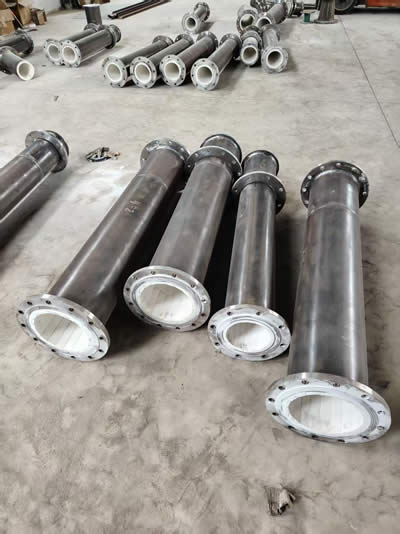
In terms of wear lifespan, ceramic-lined pipe used for fine aggregate and sand conveying offers 7–9 times longer service life than standard steel pipes. For coarse crushed stone conveying in Middle East quarries, bimetallic composite wear-resistant pipeline withstands heavy particle impact, avoiding sudden pipe rupture and material leakage. In humid Southeast Asian environments, the smooth inner lining resists mud and fine sand adhesion, greatly reducing pipeline blockage frequency during rainy seasons.
Temperature and pressure resistance is another critical advantage. Middle East daytime temperatures often exceed 50℃, causing severe thermal expansion and contraction. Qualified wear-resistant pipeline maintains structural stability without weld cracking or lining detachment. For standardized East Asian production lines, optimized pipeline wall thickness ensures stable pressure bearing capacity, avoiding flow fluctuation that affects aggregate production efficiency while complying with JIS G 3459 safety standards.
In addition, optimized inner wall roughness reduces slurry flow pressure loss, lowering long-term fan and pump energy consumption for aggregate conveying systems, a hidden efficiency gain ignored by most procurement teams.
3. Cross-Border Procurement Rules for Asian Aggregate Pipeline Projects
Procuring wear-resistant products for overseas aggregate projects cannot adopt unified domestic standards. Each regional market has unique environmental challenges and acceptance specifications that must be addressed to avoid project delays and rework costs.
For Southeast Asian aggregate projects, ocean transportation rust is a top hidden hazard. Long-term humid sea freight corrodes unprotected welds and flange surfaces. Procurement contracts must mandate thick marine anti-rust coating and fully sealed wooden box packaging. Also, reserve extra thermal expansion gaps to adapt to tropical high-temperature operating environments.
Middle East aggregate project procurement prioritizes dust-proof and high-temperature resistant configurations. All wear-resistant elbow and pipe joint gaskets must adopt high-temperature dust-proof customized accessories to prevent desert sand from invading pipeline interiors and causing abnormal abrasive wear. Outdoor pipelines also need fire-retardant outer coatings to meet local industrial safety codes.
Japanese and Korean aggregate facilities enforce extremely strict acceptance standards. All pipeline dimensions, lining thickness, and welding quality require full compliance with KS D 3562 and JIS industrial specifications. Any non-standard deviation will lead to full order rejection.
Engineer’s Pitfall Reminder 1: Never purchase standard general-purpose pipes for tropical Southeast Asian aggregate lines. Ordinary anti-rust treatment cannot resist coastal salt fog, leading to rapid outer wall corrosion.
Engineer’s Pitfall Reminder 2: Do not ignore gasket matching for Middle East pipelines. Ordinary rubber gaskets age rapidly under extreme heat, causing frequent joint leakage.
4. Regional Targeted Daily Maintenance & Fault Prevention
Proper daily maintenance doubles the service life of slurry pipeline for aggregate plants. I’ve summarized region-specific maintenance tactics tailored to Asian climatic and operational characteristics, different from generic universal guidelines.
Southeast Asian plants need post-rainseason pipeline flushing. Rainwater mixes with fine aggregate mud to form sticky sediment that adheres to inner walls, causing localized concentrated wear. Monthly anti-corrosion inspection of pipe gallery supports is also required to eliminate rust deformation from persistent high humidity.
Middle East quarry pipelines need regular dust removal for pipe joints and outer walls. Accumulated sand grains aggravate external abrasion and block thermal expansion gaps. Regular gasket replacement is necessary to maintain sealing performance in dry heat conditions.
East Asian refined aggregate workshops focus on seismic support inspection and lining thickness testing. Frequent minor vibrations in compact factories loosen pipeline fixtures, leading to lining shedding if left uninspected.
5. Exclusive Insight: Procurement Cost Performance Analysis for Wear-Resistant Pipe
Most B2B buyers judge cost performance solely by initial procurement price, which is the biggest mistake in aggregate pipeline project budgeting. True cost performance depends on total lifecycle cost, including replacement frequency, maintenance labor, and shutdown losses.
5.1 Low-Price Generic Pipes: Hidden Long-Term Losses
Generic low-cost abrasion-resistant pipe cuts 20–30** of upfront costs but uses inferior lining materials and thin outer steel tubes. In Southeast Asian and Middle East harsh working conditions, these pipes fail within 1–2 years. Frequent replacement requires repeated construction, material costs, and production shutdowns. For medium and large aggregate plants, annual shutdown losses far exceed the money saved on initial procurement.
5.2 Customized High-Quality Pipes: Real Lifecycle Cost Savings
Certified customized wear-resistant pipeline has a higher unit price but delivers 5–8 years of stable service life in Asian aggregate scenarios. It requires only routine inspection with almost no replacement or major maintenance costs. Matched regional anti-corrosion and high-temperature treatments eliminate environmental failure risks. For long-term operating industrial projects, high-quality customized solutions reduce comprehensive operational costs by over 50** compared with low-price generic options.
6. Final Summary & Practical Project Advice
For Asian aggregate plant production lines, reliable wear-resistant pipe is the core guarantee of stable and low-cost operation. Project teams must abandon simple price comparison and focus on regional working condition adaptation, field performance, and lifecycle cost performance.
Matching ceramic-lined pipe or bimetallic pipeline according to local temperature, humidity, and aggregate particle characteristics, complying with regional industrial standards during procurement, and implementing targeted maintenance can completely avoid common pipeline failures and unnecessary economic losses.
For ongoing aggregate construction and renovation projects across the Middle East, partnering with a professional wear-resistant pipe for Middle East aggregate plants is the most reliable way to balance quality and long-term cost performance.