Wear-Resistant Pipe Selection Performance and Cost Tips for Global Industrial Projects
Wear-Resistant Pipe: Selection, Performance and Cost Tips for Global Industrial Projects
After working on industrial pipeline projects across Southeast Asia, the Middle East, and Japan for over a decade, I’ve seen countless project delays and budget overruns caused by improper wear-resistant pipe selection and poor on-site application. Most B2B buyers and project engineers focus only on initial pipe prices, ignoring regional climate differences, slurry medium characteristics, and long-term maintenance costs. A qualified wear-resistant pipe is not just a simple pipeline component; it’s a core factor that determines the continuous operation efficiency of mining, power plant, cement, and dredging projects. In this article, I’ll share practical field experience on pipeline performance, material selection, regional adaptation, and cost control to help global project teams avoid common engineering pitfalls.
1. Core Application Value of Wear-Resistant Pipe in Global Industrial Scenarios
Many overseas project teams treat abrasion-resistant pipe as a universal spare part, but its actual core value varies drastically across different industrial scenarios and regional environments. Unlike ordinary carbon steel pipes that fail quickly under harsh working conditions, professional wear-resistant pipeline solutions target high-abrasion, high-corrosion, and extreme temperature working media, solving the two biggest pain points of industrial pipelines: short service life and frequent shutdown replacement.
For mining and sand and gravel aggregate projects, pipelines need to carry high-concentration ore slurry and sharp stone particles, which cause severe impact and cutting abrasion on pipe walls. For thermal power and cement plant projects, pipeline systems face long-term flue gas ash abrasion and high-temperature alternating loads. For port and dredging projects, pipelines work in long-distance slurry transportation with continuous particle scouring. In chemical and metallurgical industries, pipes need to resist both mechanical abrasion and medium corrosion.
Combined with regional field conditions, the scenario value is more targeted. In Southeast Asian mining projects, the rainy season brings high-humidity mud and acidic mine water, which simultaneously causes abrasion and electrochemical corrosion on ordinary pipelines, leading to pipe wall perforation in 3–6 months. In Middle Eastern desert mining and cement projects, continuous strong sand wind and dry heat weather accelerate surface abrasion and material aging of exposed pipelines. In Japanese industrial parks, compact factory layouts and strict operational standards require pipelines to maintain stable wear resistance in narrow installation spaces and frequent load switching scenarios.
2. Mainstream Wear-Resistant Pipe Material Performance Analysis (Pros & Cons)
Material selection is the foundation of pipeline service life. I’ve encountered many project failures caused by blindly choosing high-priced materials without matching actual working conditions. The four most widely used materials for global industrial wear-resistant pipeline systems are ceramic-lined composite, bimetallic composite, high-chromium cast iron, and polymer rubber lining. Each material has distinct advantages, weaknesses, and applicable regional working conditions.
2.1 Ceramic-Lined Pipe
Ceramic-lined pipe is the most cost-effective choice for fine slurry and low-impact abrasion working conditions. The inner alumina ceramic layer has ultra-high hardness, excellent anti-scouring performance, and smooth inner wall that effectively reduces pipeline blockage and pressure loss. Its maximum working temperature can reach 800℃, adapting to high-temperature ash transportation in power plants and cement factories. However, its obvious disadvantage is poor impact resistance; it is prone to ceramic peeling and cracking under strong impact of large-particle ore.
Engineer’s Pitfall Reminder: Do not use ceramic-lined pipe for coarse ore slurry transportation in Southeast Asian open-pit mines. Large gravel particles in rainy season mud will directly damage the ceramic lining, causing pipeline failure in a short time.
2.2 Bimetallic Composite Pipe
This pipeline adopts an outer carbon steel pipe layer and inner high-alloy wear-resistant steel layer, integrating the toughness of outer pipe and the wear resistance of inner layer. It has strong anti-impact ability, suitable for large-particle material transportation and frequent impact working conditions. It can adapt to the dry and hot extreme temperature changes in the Middle East, with stable thermal expansion and contraction performance, no lining falling off, and good welding performance for on-site cutting and modification.
The shortcoming is that its fine abrasion resistance is slightly lower than ceramic-lined pipe, and the production cost is higher, so it is not suitable for low-load conventional slurry projects.
2.3 High-Chromium Cast Iron Pipe
With high chromium alloy content, this pipe has excellent overall wear resistance and pressure resistance, suitable for high-pressure and heavy-abrasion working conditions such as coal washing and metallurgical slag transportation. It complies with ASTM A106 standard and is widely recognized in Middle Eastern and Southeast Asian heavy industrial projects. The disadvantage is heavy weight, high installation requirements, and poor seismic performance, which needs special reinforcement treatment in Japanese projects with strict seismic standards.
2.4 Polymer Rubber Lined Pipe
Rubber-lined pipeline is mainly used for corrosive and fine slurry working conditions, with good anti-corrosion and anti-blocking effect. It is suitable for chemical acid-base slurry and coastal port dredging projects with salt spray corrosion. But it cannot withstand high temperature and strong impact, and is easy to aging and harden under long-term sunlight exposure in the Middle East.
3. Pipeline Structure Design and Internal Working Principle
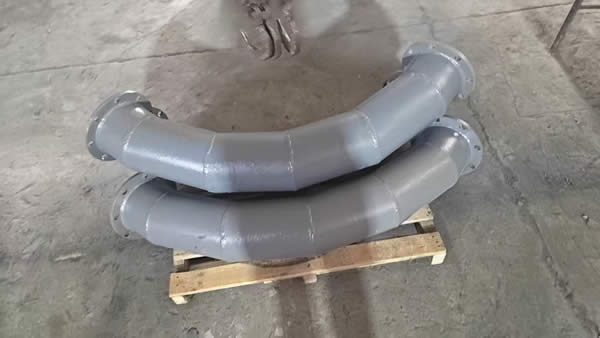
The service life of wear-resistant elbow and straight pipe depends not only on materials but also on structural design details. Many buyers only focus on material parameters and ignore structural rationality, leading to local wear and leakage of pipelines. All mainstream industrial wear-resistant pipelines adopt composite structure design, including outer protective pipe, wear-resistant inner lining, bonding transition layer, and standardized connecting structure.
3.1 Internal Structural Composition
The outer pipe is usually made of carbon steel compliant with API 5L standard, providing overall structural strength, pressure resistance, and installation rigidity. The middle transition bonding layer fixes the inner lining to avoid peeling caused by thermal expansion and vibration. The innermost wear-resistant lining undertakes all material scouring and abrasion, which is the core wear-resistant layer. For bent wear-resistant elbow with the most severe abrasion, the inner lining will be thickened locally at the impact surface to enhance impact resistance.
3.2 Regional Adaptive Structural Optimization
For Southeast Asian high-temperature and high-humidity environments, we optimize the bonding layer with anti-rust and anti-corrosion formulas to prevent bonding failure caused by salt spray and humid air. For Middle Eastern desert projects, the flange connection part adds dust-proof and heat-insulating gaskets to avoid sand and dust invasion and seal failure caused by high-temperature thermal deformation. For Japanese projects that follow JIS G 3459 standards, the pipeline welding seam and flange size adopt precise standardized design to adapt to narrow installation space and seismic support installation requirements.
4. Overseas Procurement Standards and Regional Selection Avoidance Tips
Procuring qualified wear-resistant pipeline products for overseas projects is far more complicated than domestic procurement. Different regions have unique climate conditions, industry standards, and acceptance specifications. Blind universal procurement will lead to unqualified on-site acceptance and rework losses.
4.1 Southeast Asia Project Procurement Key Points
Southeast Asia features perennial high temperature, high humidity, heavy rain, and strong salt spray in coastal areas. Pipeline procurement must prioritize double anti-corrosion and anti-abrasion performance. Ordinary single-layer wear-resistant pipes are easy to rust from the outer pipe due to salt spray corrosion, and the humid mud medium accelerates inner wall abrasion. In addition, sea transportation leads to long-term container dampness, so suppliers must provide professional anti-rust packaging and rainproof protection. Project acceptance needs to focus on the anti-corrosion treatment of pipe supports and hanger parts, which are most prone to hidden corrosion risks.
4.2 Middle East Project Procurement Key Points
Middle Eastern projects face extreme dry heat, strong sunlight, and frequent sandstorms. Pipeline selection must avoid rubber-lined products that are easy to age at high temperature. Exposed pipelines need to have anti-ultraviolet and anti-sand-blast surface treatment. The large temperature difference between day and night causes severe thermal expansion and contraction of pipelines, so flange seals must adopt high-temperature resistant materials to prevent air leakage and dust ingress. At the same time, Middle Eastern industrial parks have strict fire protection standards, and pipeline materials must meet local fire resistance specifications.
4.3 Japan and South Korea Project Procurement Key Points
Japanese and Korean projects follow JIS and KS D 3562 standards with extremely strict acceptance and refined operation requirements. Pipeline dimensional accuracy, welding seam flatness, and wall thickness uniformity have zero-tolerance standards. The installation space of factory pipeline corridors is narrow, so non-standard fixed-size customization is often required. In addition, local projects have mandatory seismic requirements, and pipelines must be matched with professional seismic supports, and the overall pipeline system needs to pass seismic load testing.
Engineer’s Pitfall Reminder: Never use generic domestic standard pipes for Japan-Korea projects. Dimensional deviations and non-compliant processes will lead to direct rejection during official acceptance, resulting in huge delivery delays.
5. Daily Operation Maintenance and Fault Prevention of Industrial Pipelines
Even the best wear-resistant pipeline system requires standardized daily maintenance to extend service life. Most overseas project teams have imperfect maintenance systems, leading to premature pipeline failure. Based on years of on-site experience, I’ve sorted out targeted maintenance strategies for different regional scenarios.
5.1 Routine Inspection and Detection
For Southeast Asian rainy season projects, regular thickness measurement of pipeline elbows and tee joints (the most worn parts) is required every month, and accumulated mud at the bottom of pipelines should be cleaned in time to avoid local accelerated abrasion. For Middle Eastern desert projects, daily inspection of flange seals and pipeline surface anti-ultraviolet coating is needed to prevent sand wind abrasion damage and seal dust leakage. For Japanese refined operation projects, daily pipeline vibration and support stability inspection is required to avoid pipeline loosening caused by long-term equipment operation vibration.
5.2 Common Fault Prevention and Treatment
Pipeline blockage is the most common fault in slurry pipeline transportation. For high-humidity and high-viscosity mud in Southeast Asia, regular high-pressure water flushing is required to prevent medium adhesion and scaling. For Middle Eastern dry sand and particle transportation, avoid empty pipe dry grinding for a long time to prevent excessive wear of inner lining. For worn elbows with serious thinning, partial replacement should be carried out in time instead of delayed maintenance, which will avoid pipeline burst and production shutdown.
5.3 Storage and Transportation Maintenance
Overseas long-distance sea transportation requires unified rainproof, moisture-proof and anti-rust packaging. After arriving at the site, pipelines should be placed on flat brackets to avoid ground moisture corrosion, especially in Southeast Asian humid environments. Middle Eastern open-air storage needs to be covered with sunshade cloth to prevent long-term high-temperature aging of pipeline auxiliary structures.
6. Exclusive Guide: B2B Procurement Cost Performance Optimization (Core Extended Section)
Most B-end buyers only compare the unit price of wear-resistant pipe in the procurement stage, ignoring the comprehensive cost of installation, operation, maintenance and replacement throughout the pipeline life cycle. In overseas industrial projects, reasonable cost performance matching can save 20**–35** of comprehensive pipeline investment for the project.
6.1 Distinguish Scenarios to Avoid Over-Configuration and Under-Configuration
Over-configuration is the most common waste in procurement. For conventional fine ash and low-concentration slurry transportation in power plants and cement plants, high-priced bimetallic and high-chromium pipes are completely unnecessary. Standard ceramic-lined pipe can meet the working conditions and reduce initial procurement cost by more than 30**. On the contrary, for coarse ore and high-impact working conditions in mining and sand and gravel projects, low-cost ordinary wear-resistant pipes will lead to frequent replacement, and the later shutdown maintenance cost is far higher than the material price difference.
Regionally targeted configuration optimization is more critical. In Southeast Asian coastal low-corrosion and medium-abrasion scenarios, composite wear-resistant pipes with ordinary anti-corrosion outer layer are sufficient. In Middle Eastern high-temperature and strong sand-abrasion scenarios, it is necessary to upgrade the surface anti-aging process, but there is no need to customize ultra-high pressure resistant structures. In this way, precise matching avoids functional redundancy and cost waste.
6.2 Control Hidden Procurement and Operation Costs
Many buyers ignore hidden costs that occupy a large proportion of project investment. First, non-standard size customization with small batches will lead to increased production and transportation costs. It is recommended to unify pipeline specifications and adopt standardized fixed-size products on the premise of meeting project needs. Second, unqualified packaging will lead to pipeline rust and lining damage during sea transportation, resulting in secondary replacement costs. Third, mismatched connecting accessories will lead to on-site installation rework and delay costs.
In addition, the long-term operating cost of the pipeline cannot be ignored. High-quality wear-resistant pipeline has smooth inner wall, low fluid resistance, and lower long-term power consumption of transmission equipment. For large-scale long-distance slurry pipeline projects, the energy-saving benefit accumulated in 2–3 years can cover the initial material price difference.
7. Article Summary and Practical Selection Conclusions
To sum up, the selection and application of wear-resistant pipe for overseas industrial projects must be based on regional climate characteristics, working medium conditions, and project operation standards, rather than blind selection by price or material reputation. Ceramic-lined pipe, bimetallic pipe, high-chromium cast iron pipe and rubber-lined pipe have their own applicable scenarios, and regional adaptive structural optimization and standardized procurement and maintenance are the keys to ensure long-term stable operation of abrasion-resistant pipe systems.
For Southeast Asian high-temperature, high-humidity and salt spray industrial projects, priority should be given to wear-resistant pipeline products with dual anti-corrosion and anti-abrasion performance and perfect marine packaging. For Middle Eastern dry heat and sand wind working conditions, high-temperature resistant and anti-aging pipeline solutions are the core choice. For Japanese and Korean refined projects that follow JIS and KS standards, standardized and high-precision customized pipelines must be matched.
As a professional wear-resistant pipe supplier in Southeast Asia, we have accumulated rich on-site engineering experience in global mining, power, cement and dredging projects. Reasonable material matching, cost performance optimization and standardized later maintenance can maximize the service life of wear-resistant pipeline, help global B-end project teams reduce operating costs and avoid engineering risks.