Wear-Resistant Pipe Selection Performance and Regional Application for Global Industrial Projects
Wear-Resistant Pipe: Selection, Performance and Regional Application for Global Industrial Projects
For over a decade, I’ve troubleshooted and optimized pipeline systems for mining, power plant, cement, and dredging projects across Southeast Asia, the Middle East, and East Asia. One consistent issue I’ve observed is premature pipeline failure caused by mismatched materials, ignored regional climatic conditions, and generic selection habits. A qualified wear-resistant pipe is never a one-size-fits-all product, and project managers who rely on standard steel pipes often face unplanned downtime, frequent replacements, and inflated maintenance costs. In this hands-on guide, I’ll share field-tested insights on pipeline performance, material matching, regional adaptation, and common selection mistakes to help B2B procurement teams and project engineers make cost-effective, long-lasting decisions for industrial slurry and abrasive medium transportation.
1. Core Value of Wear-Resistant Pipe in Global Industrial Scenarios
A wear-resistant pipe, also widely known as an abrasion-resistant pipe, is a specialized pipeline component designed to withstand continuous friction, impact, and corrosion from abrasive media like ore slurry, cement clinker, coal ash, sediment, and chemical granular materials. Unlike ordinary carbon steel pipes that suffer rapid wall thinning and cracking under harsh operating conditions, professional wear-resistant pipeline solutions focus on extending service life, stabilizing fluid transportation, and reducing overall project operational costs.
In global industrial projects, its core value varies by scenario. For mining and aggregate projects, it resists high-speed ore particle impact and slurry abrasion; for thermal power and cement plants, it handles long-term ash and clinker friction; for port and dredging projects, it adapts high-flow sediment and seawater mixed media. For B-end buyers, the biggest advantage is cutting frequent pipeline replacement labor costs and avoiding production shutdown losses caused by pipe burst or blockage.
2. Mainstream Wear-Resistant Pipe Material Performance Analysis
After auditing hundreds of overseas project pipeline failures, I confirm that 70** of pipeline service life problems stem from incorrect material selection. Each mainstream wear-resistant material has unique strengths and inherent weaknesses, with strict adaptation to media, temperature, and regional climate conditions.
2.1 Ceramic-Lined Pipe
Ceramic-lined pipe is the most widely used wear-resistant pipeline for fine particle slurry and low-impact scenarios. Its inner alumina ceramic layer features ultra-high hardness and excellent anti-abrasion performance, with a service life 8-10 times that of ordinary steel pipes. It performs well in chemical slurry transportation, cement powder conveying, and coastal dredging projects. However, my field reminder: ceramic lining is brittle and cannot withstand heavy material impact, making it unsuitable for large ore particle mining scenarios. It also requires strict anti-collision protection during marine transportation for Southeast Asian projects.
2.2 Double Metal & Hardfacing Welded Pipe
Double metal composite pipes and hardfacing welded pipes take high chromium alloy as the wear-resistant layer and carbon steel as the outer protective pipe. This structure balances impact resistance and pressure resistance perfectly. It adapts to high-impact working conditions such as coarse ore transportation and coal washing plants. The downside is poor high-temperature oxidation resistance; under continuous Middle Eastern dry heat and strong sunlight exposure, the alloy layer is prone to surface aging if not insulated properly.
2.3 Rubber & Polymer Lined Pipe
Rubber and polymer lined pipes excel in anti-corrosion and anti-blocking performance, ideal for acidic mine water and wet slurry environments common in Southeast Asian rainy seasons. Their flexible inner layer buffers medium impact and avoids scaling effectively. The key limitation is temperature resistance: most rubber liners fail above 80°C, so they cannot be used for high-temperature flue gas and ash conveying in thermal power plants.
3. Structural Design and Internal Working Principle
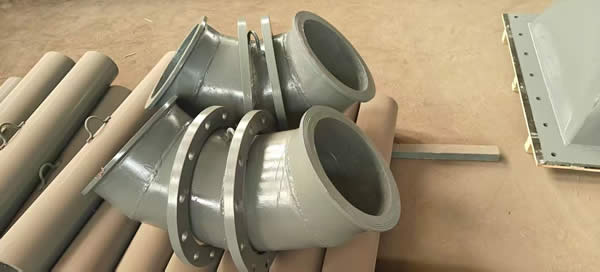
The stable operation of a wear-resistant elbow and straight pipe depends entirely on its layered structural design, not just surface wear-resistant treatment. Standard qualified industrial wear-resistant pipeline consists of three core layers and standardized connecting structures, which I always verify first during overseas project acceptance.
3.1 Three-Layer Composite Structure
The outermost layer is a thickened carbon steel outer pipe (complying with ASTM A106 and API 5L standards), bearing pipeline pressure, external mechanical extrusion, and climatic erosion. The middle bonding layer tightly combines the outer pipe and inner wear-resistant layer to prevent delamination and peeling during long-term fluid scouring. The innermost professional wear-resistant layer undertakes all abrasive friction and medium corrosion, which determines the core service life of the pipeline.
3.2 Connection Structure and Operational Stability
Global projects mainly adopt three connection methods: welding, flange connection, and clamp connection. Welding is suitable for fixed pipe racks in heavy industrial projects; flange connection is widely used in Middle Eastern projects, where sealed flanges can effectively block sand and dust from entering pipeline gaps under dry and windy conditions. Clamp connection is favored by Japanese and Korean projects for its fast installation and easy maintenance, matching their limited on-site construction space and refined operation requirements.
4. Key Performance Parameters and On-Site Operating Efficiency
When evaluating slurry pipeline quality, B-end buyers should not only focus on price but also core performance indicators that directly affect long-term operating efficiency. Based on my overseas project data, I summarize the most practical performance parameters for industrial selection.
4.1 Wear Life and Impact Resistance
Different materials have distinct wear resistance thresholds. Ceramic-lined pipes perform best in fine slurry scouring, while hardfaced pipes dominate heavy impact working conditions. For Southeast Asian mining projects with year-round high humidity and acidic slurry, the wear loss of ordinary wear-resistant materials will increase by 30** annually, so it is necessary to select thickened wear-resistant layers.
4.2 Pressure Resistance, Temperature Resistance and Flow Loss
Standard industrial wear-resistant pipes can withstand 1.0-10MPa pressure, meeting most mining and chemical project needs. In Middle Eastern ultra-dry and hot environments (temperature exceeding 50°C on site), pipelines face severe thermal expansion and contraction, requiring standardized wall thickness design to avoid pipe deformation. Smooth inner walls of qualified pipelines effectively reduce flow pressure loss, improving slurry transportation efficiency by 10**-15** compared with traditional lined pipes.
4.3 Anti-Blocking and Anti-Scaling Performance
Smooth ceramic and polymer inner layers effectively prevent material scaling and pipeline blockage, a critical advantage for rainy season dredging and mining projects in Southeast Asia with high mud concentration. This greatly reduces manual cleaning frequency and shutdown maintenance time.
5. Regional Procurement & Installation Notes for Overseas Projects
Different regional climates and project standards lead to completely different pipeline selection and construction requirements. Generic procurement schemes are the main cause of overseas project pipeline failure. Below are my targeted field experience for Southeast Asia, Middle East, and Japan-South Korea markets.
5.1 Southeast Asia: High Humidity, Salt Fog and Rainy Season Adaptation
Southeast Asian projects feature perennial high temperature, high humidity, and coastal salt fog erosion. Ordinary carbon steel outer pipes are prone to rust and corrosion during sea transportation and on-site storage. My core procurement reminder: all exported pipelines must adopt anti-rust paint and sealed wooden box packaging to avoid salt fog corrosion. In addition, acidic mine water in local rainy seasons accelerates inner wall wear, so priority should be given to polymer or ceramic-lined anti-corrosion wear-resistant pipe solutions.
5.2 Middle East: Dry Heat, Sand Erosion and Thermal Expansion Control
Middle Eastern desert projects face strong sunlight, dry heat, and frequent sandstorms. Outdoor exposed pipelines suffer continuous sand abrasion on the outer wall, and large temperature differences between day and night cause severe thermal expansion and contraction. Engineer’s避坑 tip: Do not use thin-walled composite pipes; adopt reinforced flange sealing structures to prevent dust from entering pipeline joints and avoid leakage. Meanwhile, pipeline surface heat insulation treatment is required to delay material aging.
5.3 Japan & South Korea: Refined Construction and Standard Compliance
Japanese and Korean industrial projects strictly follow JIS G 3459 and KS D 3562 standards, with extremely strict acceptance and installation requirements. Local project sites have narrow construction space, requiring customized short-size pipelines and compact wear-resistant elbow structures. In addition, seismic support fixation must be matched to adapt to local seismic working conditions, and all pipeline parameters need full standard certification documents for acceptance.
6. Exclusive Guide: Common High-Frequency Wear-Resistant Pipe Selection Misconceptions
After 10 years of overseas project service, I have summarized two most common selection misconceptions of procurement engineers and project leaders, which are also the main reasons for excessive project cost and short pipeline service life.
6.1 Misconception 1: Higher Hardness Equals Longer Service Life
Many buyers blindly pursue ultra-high hardness materials and ignore working condition matching. In fact, ultra-hard ceramic materials are brittle and easy to crack under strong impact of large ore particles. For heavy impact mining working conditions, high-toughness hardfaced wear-resistant pipes have a far longer service life than high-hardness ceramic pipes. Hardness only represents anti-scouring ability, while impact toughness determines the overall stability of the pipeline system.
6.2 Misconception 2: Uniform Standard Pipes Fit All Regional Projects
The biggest procurement mistake for cross-border projects is adopting unified standard pipelines for different regions. For example, standard pipes suitable for European temperate climates will rust rapidly in Southeast Asian salt fog environments and age quickly in Middle Eastern dry heat. Japan and South Korea’s strict standard parameters and narrow installation space also cannot adapt to universal standard pipe sizes. Regional customized optimization is indispensable for long-term stable operation.
7. Daily Operation Maintenance and Fault Prevention Tips
Even the best wear-resistant pipeline system requires standardized daily maintenance to avoid premature failure. I have sorted out the most practical on-site maintenance procedures suitable for global industrial projects.
First, regular wall thickness inspection and rust removal: For outdoor pipelines in Southeast Asia and the Middle East, conduct monthly thickness measurement and surface rust removal to prevent outer wall corrosion from penetrating and damaging the inner wear-resistant layer. Second, regular inspection of flange joints: Check sealing performance frequently for Middle Eastern sandstorm environments to prevent dust infiltration and leakage. Third, timely replacement of vulnerable parts: Wear-resistant elbows are the most worn parts in slurry transportation systems, and should be replaced regularly according to operating data to avoid sudden pipe burst. Fourth, standardized storage: Avoid open-air stacking in rainy and high-temperature environments to prevent lining aging and outer pipe corrosion.
Conclusion
Selecting a suitable wear-resistant pipe is a systematic project integrating material performance, regional working conditions, project standards, and later maintenance. Blindly pursuing low prices or single high performance will bring hidden costs such as downtime maintenance and frequent replacement. Whether it is ceramic-lined pipe for anti-corrosion slurry transportation, hardfaced pipe for heavy impact mining, or customized wear-resistant pipeline for refined East Asian projects, working condition matching is always the core of selection. For mining, cement, and dredging projects in Southeast Asia and the Middle East, choosing a professional wear-resistant pipe supplier in Southeast Asia with rich regional project experience can effectively avoid selection mistakes and ensure long-term stable operation of the pipeline system.