Wear-Resistant Pipe Specs Customization and Regional Installation Best Practices
Wear-Resistant Pipe: Specs, Customization and Regional Installation Best Practices
Having spent over a decade solving pipeline failure issues for global aggregate, cement, and chemical projects, I’ve witnessed a recurring costly mistake: B2B procurement teams prioritize standard specs over project-specific customization and regional installation conditions. A properly tailored wear-resistant pipe can cut annual maintenance costs by 60** for harsh overseas sites, while generic off-the-shelf models often fail within a single rainy or dry season. This hands-on guide shares my field-tested experience on pipeline specs, custom engineering, regional installation rules, and hidden procurement pitfalls for Southeast Asian, Middle Eastern, and East Asian industrial projects.
1. Performance & Efficiency Metrics for Industrial Wear-Resistant Pipeline
Most product datasheets list ideal lab performance data, but field operation tells a different story. For industrial slurry pipeline and material conveying systems, three core metrics determine long-term operational efficiency: wear lifespan, pressure and temperature tolerance, and flow pressure loss. These factors directly define the practical value of abrasion-resistant pipe in real project scenarios.
In terms of wear resistance, qualified composite pipelines deliver 7–12 times longer service life than ordinary seamless steel pipes when handling sharp gravel, cement clinker dust, and chemical mixed slurry. For pressure resistance, standard pipes comply with ASTM A106 and API 5L standards, supporting medium and high-pressure conveying for mining and chemical production lines. More importantly, smooth inner walls of optimized wear-resistant elbow and straight pipe reduce flow resistance effectively, avoiding material deposition and energy waste that plague traditional rough steel pipelines.
Impact resistance is another critical field indicator. Unlike brittle single ceramic structures, composite wear-resistant pipelines withstand frequent material impact in aggregate and cement production lines, preventing sudden pipe rupture and unplanned project shutdowns.
2. Full Category Classification & Scenario Adaptation
There is no universal wear-resistant pipeline for all industrial conditions. Each pipe type and connection method is designed for specific media, environment, and installation scenarios. As an on-site engineer, I categorize mainstream products by structure and connection type for accurate project selection.
2.1 Pipe Structure Classification
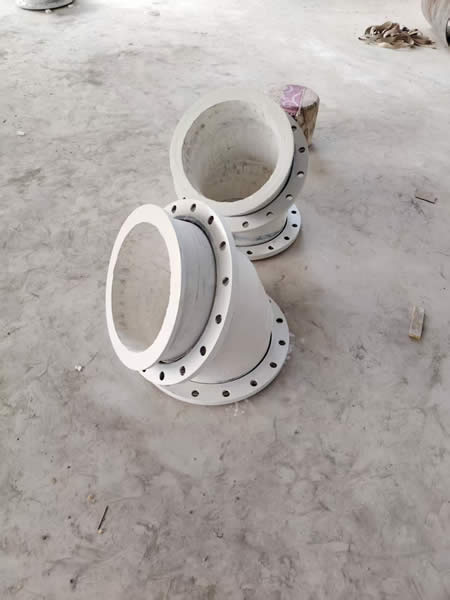
Straight pipes are used for long-distance horizontal and vertical material conveying, serving as the main body of all pipeline systems. Wear-resistant elbow is the most vulnerable component in the entire pipeline, bearing 80** of slurry and particle scouring impact, so it always requires upgraded wear-resistant materials. Tees and reducers are customized for branch conveying and pipeline diameter conversion, commonly used in chemical and cement plant material distribution systems.
2.2 Material & Connection Types
Mainstream types include ceramic-lined composite, high-chromium cast iron, surfacing welded, and rubber-lined pipelines. Ceramic-lined pipe suits fine slurry and low-temperature corrosion working conditions; high-chromium cast iron pipes excel in heavy particle impact scenarios for aggregate mining; rubber-lined pipelines are ideal for chemical acid-base medium conveying.
Connection methods cover welding, flange connection, and clamp connection. Welding ensures overall tightness for fixed long-distance pipelines, flange connection facilitates quick disassembly and maintenance, and clamp connection is widely used for temporary and frequently adjusted industrial pipelines.
3. Custom Size & Non-Standard Engineering Customization Rules
Over 40** of overseas project pipeline failures stem from mismatched standard sizes and on-site installation spaces. Standard DN/OD specs cannot adapt to all regional project conditions, making non-standard customization an essential part of cross-border pipeline procurement.
3.1 Conventional Standard Spec Parameters
Regular wear-resistant pipe covers DN50 to DN800 common calibers, with conventional wall thickness ranging from 6mm to 20mm and single pipe length of 3m or 6m. Standard elbow angles include 45°, 90°, and 180°, which meet most conventional industrial layout needs. All standard specs can match ISO 9001 quality certification and international industrial pipeline standards.
3.2 Non-Standard Customization for Overseas Special Scenarios
Overseas projects often require personalized customization. Japan and South Korea’s industrial plants feature compact equipment layout and narrow installation space, requiring ultra-short pipeline sections and small-radius customized wear-resistant elbow that comply with JIS G 3459 and KS D 3562 standards. Middle East thermal power projects need ultra-long single pipes to reduce flange connection points, minimizing sand dust leakage risks. Southeast Asian dredging projects require thickened wear-resistant layers to cope with high-concentration muddy slurry scouring in rainy seasons.
Engineer’s Pitfall Reminder: Do not force standard pipes for non-standard project layouts. Forced installation will cause excessive pipeline stress, accelerated wear at joints, and hidden leakage risks.
4. Regional Overseas Procurement & Installation Adaptation Guide
Different regional climates and local standards completely change pipeline selection, packaging, and installation strategies. Below are targeted field adaptation rules summarized from years of cross-border project experience.
4.1 Southeast Asia: High Humidity, Salt Spray and Rainy Season Mud Conditions
Southeast Asian coastal mining and dredging projects face year-round high temperature, high humidity, and salt spray corrosion. Ordinary pipe outer coatings peel off within months, and unprotected flanges rust severely during sea transportation. All exported pipelines must adopt heavy-duty marine anti-rust coating and fully sealed moisture-proof packaging. In addition, acidic mine water in local mines accelerates inner wall corrosion, so acid-resistant ceramic-lined pipe is prioritized for slurry conveying systems.
4.2 Middle East: Dry Heat, Strong Sunlight and Sand Abrasion
Middle East cement and power plant projects suffer from extreme diurnal temperature differences and frequent sandstorms. Pipeline thermal expansion and contraction is obvious, so installation must reserve professional expansion gaps for all flange joints. Sand dust easily invades unprotected sealing gaps, causing pipeline jamming and medium leakage. Meanwhile, long-term strong sunlight accelerates aging of rubber-lined pipelines, which are not recommended for outdoor overhead laying in Middle East sites.
4.3 Japan & South Korea: Seismic Standards and Strict Fine Installation
East Asian projects enforce strict seismic design and ultra-strict acceptance standards. All pipeline supports must be equipped with professional seismic brackets, and welding seam flatness, wall thickness tolerance, and connection tightness must fully comply with local national standards. On-site installation requires fine construction to avoid later operation and maintenance risks, with zero tolerance for irregular construction.
Engineer’s Pitfall Reminder: Never apply domestic installation processes to Japanese and Korean projects. Substandard construction will directly lead to project acceptance failure and delayed delivery.
5. Exclusive: Transportation & On-Site Installation Key Points (Field Verified)
Many procurement teams only focus on product quality but ignore transportation protection and standardized installation, causing new pipeline damage before formal operation. This exclusive chapter sorts out core controllable points for cross-border transportation and on-site installation.
5.1 Cross-Border Transportation Protection Measures
For long-distance sea freight to Southeast Asia and the Middle East, pipeline ends must be sealed with plastic covers to prevent seawater, rainwater, and dust from entering the pipe body. Wear-resistant elbow and other vulnerable pipe fittings need independent wooden box packaging and cushioning protection to avoid collision damage during container transportation. Bulk pipelines need fixed binding to prevent friction and coating damage during sea transportation jolting.
5.2 On-Site Standard Installation Specifications
On-site installation must follow the principle of avoiding concentrated stress. Pipeline slope should be adjusted according to slurry conveying direction to prevent material deposition and pipe blockage. In high-wind and sandy Middle East sites, overhead pipelines need wind-proof fixing measures; in humid Southeast Asian sites, pipelines must be installed on elevated brackets to avoid ground moisture corrosion. After installation, all flange sealing points need secondary dust-proof and waterproof protection to adapt to local harsh outdoor environments.
6. Conclusion
The stable operation of industrial wear-resistant pipe depends on reasonable type selection, accurate engineering customization, standardized transportation and installation, and regional environmental adaptation. Generic selection and construction methods cannot adapt to the differentiated working conditions of Southeast Asian, Middle Eastern, and East Asian projects. Reasonable matching of abrasion-resistant pipe types and strict implementation of regional installation standards can effectively reduce pipeline failure rates and long-term project operating costs.
For cement, mining and chemical enterprises undertaking overseas construction, cooperating with a professional wear-resistant pipe supplier for Middle East mining can effectively avoid cross-border engineering pitfalls and ensure long-term stable operation of slurry pipeline systems.