
Wear-Resistant Pipe Structure Maintenance and Acceptance Guide for Global Plants
Wear-Resistant Pipe Structure, Maintenance and Acceptance Guide for Global Plants
With over 10 years of field consulting experience for global metallurgical and waste-to-energy plant projects, I’ve witnessed countless pipeline shutdowns caused by neglected structural defects and unstandardized acceptance processes. A qualified wear-resistant pipe is the core guarantee for stable delivery of high-temperature ash, corrosive slag, and abrasive granular media in industrial plants. Most B2B procurement teams only verify basic pipe parameters, ignoring internal structural rationality and post-delivery hidden acceptance costs, which leads to frequent leakage, lining detachment and short service life. This article shares practical structural knowledge, regional procurement rules, daily maintenance techniques, and exclusive acceptance cost control experience for industrial wear-resistant pipeline systems.
Basic Introduction & Industrial Application Value of Wear-Resistant Pipe
Unlike ordinary industrial steel pipes, wear-resistant pipe is a composite structural component designed specifically for high-abrasion, high-corrosion and high-temperature industrial working conditions. Its core function is to resist continuous scouring of solid particles, corrosive media and thermal impact, solving the common failure problems of pipeline thinning, blockage and rupture in harsh industrial environments. It is widely applied in core links of global metallurgy, waste incineration, chemical and cement projects, delivering irreplaceable value for continuous and safe production.
Core Application Scenarios Overseas
In metallurgical projects, abrasion-resistant pipe undertakes the conveying of high-temperature sintering ore powder and metal slag slurry, bearing dual damage of high temperature and particle abrasion. For waste-to-energy plants, the pipeline needs to adapt to mixed flue gas ash and corrosive waste residue media, requiring both wear resistance and anti-corrosion performance. In coastal chemical and cement projects in Southeast Asia, it resists acidic slurry erosion and humid salt spray corrosion, while Middle East metallurgical facilities rely on it to withstand long-term sand dust scouring and extreme temperature differences.
Internal Structure & Working Principle of Wear-Resistant Pipeline
The stable performance of a wear-resistant pipeline entirely depends on its layered composite structure. Many on-site failures are caused by unqualified bonding layers and rough welding processes, rather than inferior raw materials. As a field engineer, I always prioritize structural inspection over simple material parameter checking for all incoming pipeline acceptance.
Layered Structural Composition
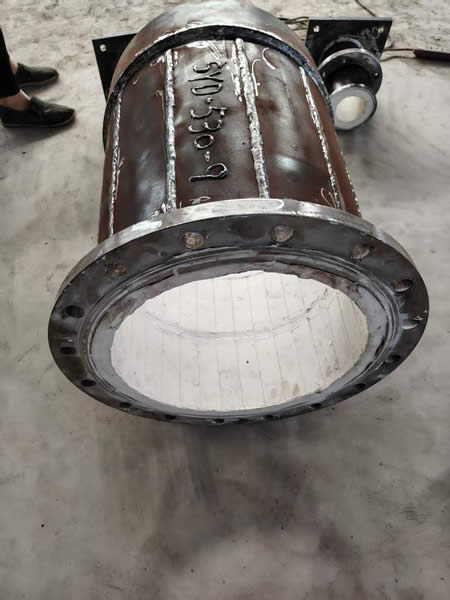
The complete pipeline consists of three core parts: outer steel pipe, intermediate bonding layer, and inner wear-resistant lining. The outer pipe usually adopts ASTM A106 standard seamless steel pipe, providing overall structural strength, pressure resistance and mechanical protection. The intermediate bonding layer is the key to fixing the lining, which needs to fit closely with the outer pipe and inner lining to avoid hollowing and peeling. The inner lining is the functional layer, including ceramic, high-chrome cast iron and polymer materials, undertaking all abrasion and corrosion resistance work.
Connection Structure & Operating Logic
Most industrial wear-resistant elbow and straight pipe products adopt integrated flange connection or seamless welding structure. The integrated forming process avoids structural gaps at joints, which are the most vulnerable parts to media scouring. During operation, the smooth inner lining isolates the steel matrix from external abrasive media, and the rigid outer pipe supports pipeline pressure and external mechanical impact, realizing long-term stable operation under complex working conditions.
Regional Overseas Procurement Guidelines for Three Core Markets
Procurement standards and adaptation requirements vary drastically across Southeast Asia, the Middle East, and Japan and South Korea. Universal procurement schemes will definitely lead to site adaptation failures. I have summarized targeted procurement and selection rules based on regional climatic characteristics and project standards.
Southeast Asia: Salt Spray Corrosion & Humid Working Condition Selection
Southeast Asian metallurgical and chemical plants are located in tropical monsoon zones, with perennial high temperature and humidity and severe coastal salt spray. Ordinary outer steel pipes are prone to surface oxidation and pipe gallery bracket corrosion. The rainy season brings a large amount of acidic mine water and muddy slurry, which accelerates local pipeline wall abrasion. In sea transportation, unqualified waterproof packaging will cause flange and weld rust before on-site installation. Engineer’s Pitfall Reminder: Never omit outer pipe anti-rust coating and marine waterproof packaging for Southeast Asian orders, as rusted joints will cause irreversible sealing failure.
Middle East: Dry Heat Aging & Sand Abrasion Adaptation
Middle East industrial projects feature extreme dry heat, intense solar exposure and frequent sandstorms. The large temperature difference between day and night causes repeated thermal expansion and contraction of pipelines, easily loosening flange sealing structures. Floating sand in the desert causes continuous micro-abrasion on outdoor pipeline surfaces, and unprotected lining is prone to high-temperature aging. In addition, local industrial projects have mandatory fireproof requirements for all overhead slurry pipeline systems.
Japan & Korea: Standardized Acceptance & Compact Installation Requirements
Projects in Japan and South Korea strictly follow JIS G 3459 and KS D 3562 industrial standards with zero-tolerance acceptance. The on-site installation space of metallurgical and power plants is extremely compact, requiring precise non-standard sizing of pipelines. All pipeline systems must be matched with professional seismic brackets to adapt to local seismic geological conditions, and suppliers need to provide complete ISO 9001 certified inspection reports for every batch of products. Engineer’s Pitfall Reminder: Do not use domestic standard size pipes for Northeast Asian projects; dimensional deviation will lead to direct rejection during official acceptance.
Daily Inspection & Maintenance Methods to Extend Pipeline Service Life
Reasonable daily maintenance can increase the service life of wear-resistant pipeline by 40**–60**, which is a low-cost and high-efficiency management method ignored by most project teams. Combined with the operating characteristics of metallurgy and waste incineration projects, I have sorted out targeted on-site maintenance specifications.
Regular Inspection & Thickness Detection
Focus on monthly ultrasonic thickness measurement of vulnerable parts such as wear-resistant elbow and tee joints, where abrasion is 3–5 times higher than straight pipe sections. For Southeast Asian projects, regularly check the anti-corrosion layer of pipe supports and eliminate rust in time. For Middle East outdoor pipelines, inspect lining aging and sand abrasion marks after sandstorms. Record all detection data to formulate a scientific replacement cycle plan.
On-Site Maintenance & Fault Prevention
Clean pipeline internal scale and residual slag regularly to prevent media adhesion from causing local accelerated abrasion and blockage. For minor lining peeling and wall thinning, use professional wear-resistant repair materials for reinforcement. For severely worn joints, replace accessories in advance to avoid sudden pipe burst. In addition, store idle pipes in a dry and ventilated environment to avoid rain and sun exposure leading to structural aging.
Exclusive Module: Project Acceptance Checklist & Hidden Cost Control
Many B-end buyers only focus on product unit price during procurement, ignoring hidden costs generated by unstandardized acceptance and unqualified incoming inspection. These invisible expenses often exceed the initial procurement savings and become a major burden for project operation.
Core On-Site Acceptance Checklist for Export Pipelines
- Structural inspection: Check the bonding tightness of the inner lining and the flatness of the welding seam to eliminate hollowing and crack defects;
- Dimension standard inspection: Verify pipe diameter, wall thickness and flange size to match local JIS/KS/ASTM regional standards;
- Environmental adaptation inspection: Check anti-rust coating, waterproof packaging and high-temperature aging resistance according to project location;
- Pressure resistance test: Conduct hydraulic pressure test to ensure no leakage under rated working pressure.
Common Hidden Acceptance Costs & Avoidance Strategies
The most common hidden cost is rework and replacement caused by unqualified acceptance. For example, pipes without salt spray anti-corrosion treatment will rust after arriving at Southeast Asian ports, requiring secondary polishing and coating. Products that do not meet Middle East fireproof standards cannot be put into use directly, resulting in idle equipment costs. In addition, unqualified dimensional accuracy will lead to on-site installation reprocessing, wasting construction time and labor costs. The best avoidance strategy is to complete full standard docking and pre-shipment inspection according to regional working conditions before delivery.
Conclusion
The stable operation of industrial wear-resistant pipe relies on reasonable structural design, regionally targeted procurement selection, standardized daily maintenance and strict acceptance management. Different from ordinary steel pipes, wear-resistant pipeline systems need to adapt to the high-humidity salt spray of Southeast Asia, dry and hot sand abrasion of the Middle East, and high-standard refined construction of Japan and Korea. Controlling acceptance hidden costs is the key to reducing overall project expenditure. For metallurgical and chemical enterprises in Southeast Asia, cooperating with a professional wear-resistant pipe supplier in Southeast Asia can effectively solve regional adaptation and acceptance problems, ensuring long-term stable pipeline operation.